The switching behaviour of a MOS device is characterized by an important parameter called the threshold voltage (Vth), which is defined as the minimum voltage, that must be established between the gate and the source (or between the gate and the substrate, if the source and the substrate are shorted together), to enable the device to conduct (or "turn on").
In the enhancement mode device, the channel is not established and the device is in a non-conducting (also called cutoff or sub-threshold ) state, for  . Note that for an enhancement nMOS transistor, the threshold voltage Vth>0. If the gate is connected to a suitable positive voltage with respect to the source, then the electric field established between the gate and the source will induce a charge inversion region, whereby a conducting path is formed between the source and the drain . In the enhancement mode device, the formation of the channel is enhanced in the presence of the gate voltage.
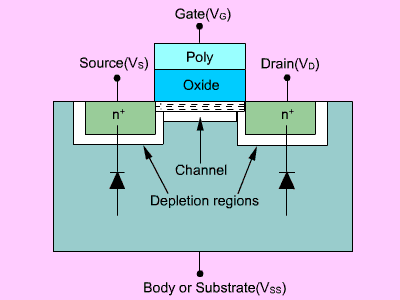
Figure 2.2: Structure of an nMOS enhancement mode transistor. Note that VGS > Vth , and VDS =0.