The condition  means that
  on S. This specifies the potential function on S and is called Dirichlet boundary condition. On the other hand,
  means
means 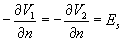 on S. Specification of the normal derivative of the potential function is called the Neumann boundary condition and corresponds to specification of normal electric field strength or charge density. If both the Dirichlet and the Neumann boundary conditions are specified over part of S then the problem is said to be over specified or improperly posed.
Method of Images
Form uniqueness theorem, we have seen that in a given region if the distribution of charge and the boundary conditions are specified properly, we can have a unique solution for the electric potential. However, obtaining this solution calls for solving Poisson (or Laplace) equation. A consequence of the uniqueness theorem is that for a given electrostatics problem, we can replace the original problem by another problem at the same time retaining the same charges and boundary conditions. This is the basis for the method of images. Method of images is particularly useful for evaluating potential and field quantities due to charges in the presence of conductors without actually solving for Poisson’s (or Laplace’s) equation. Utilizing the fact that a conducting surface is an equipotential, charge configurations near perfect conducting plane can be replaced by the charge itself and its image so as to produce an equipotential in the place of the conducting plane. To have insight into how this method works, we consider the case of point charge Q at a distance d above a large grounded conducting plane as shown in figure 2.24.