Here the surface S consists of Sr as well as S1 , S2, .....S3.
We note that Vd =0 over the conducting boundaries, therefore the contribution to the surface integral from these surfaces are zero. For large surface Sr , we can think the surface to be a spherical surface of radius  . In the surface integral, the term
  varies as
  whereas the area increases as r2, hence the surface integral decreases as
  . For , the integral vanishes.
Therefore,  . Since
  is non negative everywhere, the volume integral can be zero only if
  , which means V1 = V2. That is, our assumption that two solutions are different does not hold. So if a solution exists for Poisson’s (and Laplace’s) equation for a given set of boundary conditions, this solution is a unique solution.
Moreover, in the context of uniqueness of solution, let us look into the role of the boundary condition. We observe that, 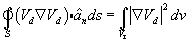 , which, can be written as
 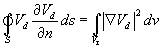 . Uniqueness of solution is guaranteed everywhere if
  or
or  =0 on S.