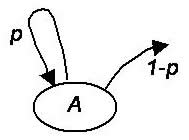
Consider a Discrete Time Markov Chain which is currently in state A. Let p be the probability that the system remains in state A at the next time instant and (1-p) is the probability that it goes to some other state. This may be represented by the figure shown below.
 |
|---|
Discrete Time Markov Chain (Transition from State A)
We can then find the probability of the system staying in state A for N time units before exiting from state A as follows -
| P{system stays in state A for N time units | given that the system is currently in state A} = pN P{system stays in state A for N time units before exiting from state A} = pN (1-p) |
| Note that the above distribution is Geometric, which is also memoryless in nature. |
Similarly, consider a Continuous Time Markov Chain which is in state A at time t. Let μ be the rate at which the system leaves state A so that the probability of its leaving state A in time interval Δt is μΔt. Then (1-μΔt) will be the probability that the system remains in state A at the time instant t+Δt.
This may be represented by the figure shown below.
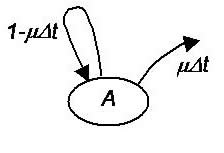
Continuous Time Markov Chain (Transition from State A)
We can then find the probability of the system staying in state A for a time interval of length T units before exiting from state A as follows -
P{system in state A for time T | system currently in state A} = (1 - μΔt )T /Δt → e- μT for Δt → 0 |
| Note that this distribution is Exponential, which is also memoryless in nature. |