| |
Brewster Angle |
|
Breswter angle is the angle of incidence for which there is no reflection from the media interface i.e it is the
angle of incidence for which the reflection coefficient is zero. |
|
|
|
Brewster Angle for Dielectric Interface |
| |
|
|
For a dielectric interface the permeablilities of both the media's are same as that of the free space. |
| |
|
|
There is no Brewster angle for perpendicular polarization. |
| |
|
|
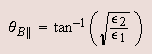
For parallel polarization equating the reflection coefficient to zero we get the Brewster angle as |
|
|
Since tangent of an angle can attain any value between zero and infinity for any value of  , ,  the Brewster
angle exist. That means for every dielectric interface there exist an angle of incidence at which there is
complete transmission of electro magnetic wave across the interface. the Brewster
angle exist. That means for every dielectric interface there exist an angle of incidence at which there is
complete transmission of electro magnetic wave across the interface. |
|
|
|
If an arbitrary polarized wave is incident at the Brewster angle the parallel polarization is completely transmitted but
the perpendicular polarization is only partially transmitted. The reflected wave then has only perpendicular
polarization irrespective of the polarization of the incident wave. In other words, the reflected wave is linearly
polarized (perpendicular polarization) irrespective of the state of polarization of the incident wave. |
|
|
|
Even a randomly polarized wave incident at Brewster angle produces a linearly polarized wave after reflection.
The Brewster angle therefore is also called he 'POLARIZING ANGLE' |
|
|
|
Note: |
|
Although the Brewster angle exist for only parallel polarization at the dielectric interface, in principle there could
be Brewster angle's for both polarizations if the permeablilities of two media are not same. |
|