The Hertz dipole has a limitation that its radiation resistance is too small and consequently is not a very efficient radiator.
In practice dipole antennas of lengths comparable to the wavelength are used.
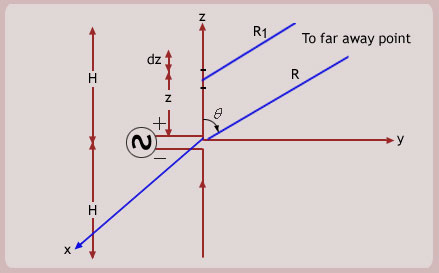
A dipole antenna of length 2H oriented in the z-direction with its center at the origin of the coordinate system is shown in Fig.
For these antennas since the length is comparable to the wavelength, the current distribution can not be uniform as we assumed for the Hertz dipole.
However, as we mentioned, obtaining the current distribution is a difficult task and is beyond the scope of this course.
The rigorous analysis show that the current distribution on a linear dipole antenna is sinusoidal with zero current at the ends of the antenna. The current distribution is given as
The radiation electric field due to the dipole can be obtained by dividing the dipole into small Hertz dipoles with appropriate currents and superposing their radiation fields with proper phase.
Assuming that , the total field at a point is given as
Where we have defined
The function gives the variation of the electric field as a function of , and hence gives the E-plane radiation pattern of the dipole.




 , the total field at a point is given as


 gives the variation of the electric field as a function of
  , and hence gives the E-plane radiation pattern of the dipole.
