For the Hertz dipole, the magnetic field has only -component and the electric field does not have the -component. The electric field lies in the plane.
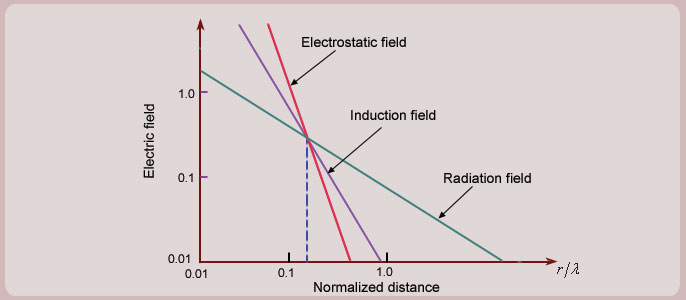
The fields can be divided into three categories depending upon their variation as a function of distance.
The field which varies as , is called the electrostatic field. This field is dominant in the close vicinity of the dipole since its amplitude decreases rapidly as function of distance.
The field which varies as , is called the induction field . This field extends little further than the electrostatic field but still decays rapidly as a function of distance.
The field which varies a is called the radiation field . This is the field which extends over farthest distance from the antenna and is responsible for the radiation of power from the antenna.
The electrostatic field is inversely proportional to the frequency. As the frequency of the current approaches zero, this field diverges to infinity. This field is essentially due to the accumulation of charges on the tip of the antenna. When the current flows in the dipole, the opposite charges get accumulated on the tips of the antenna giving a dipole. With the reversal of the current (every half cycle) dipole reverses its polarity giving an oscillating dipole. The electrostatic field is due to this oscillating dipole. As the frequency decreases, the accumulated charge for a given current increases and therefore the electrostatic field increases.
The Induction field is independent of frequency. This field has same behavior as the magnetic field obtained from the Biot-Savart law, and hence the name given to the field.
The radiation field is proportional to the frequency. This field is therefore practically absent at low frequencies. This field is essentially a high frequency phenomenon.
The electrostatic and the induction fields together are called the Near Fields, and the radiation fields are called the Far Fields.
The three field become equal in magnitude at a distance of as shown in Fig. The distance within is called the near-field zone and the distance is called the far-field zone.


 -component and the electric field does not have the
  -component. The electric field lies in the
  plane.
  , is called the electrostatic field. This field is dominant in the close vicinity of the dipole since its amplitude decreases rapidly as function of distance.
  , is called the induction field . This field extends little further than the electrostatic field but still decays rapidly as a function of distance.
  is called the radiation field . This is the field which extends over farthest distance from the antenna and is responsible for the radiation of power from the antenna.
  as shown in Fig. The distance within
  is called the near-field zone and the distance
  is called the far-field zone.