|
Dot Product
(Inner Product) of Vectors :
In simple language,
the Dot product (Inner product or Scalar product) is
a binary operation which takes two vectors and returns
a scalar quantity. The Dot
product of two vectors X and Y, both of 'N' dimensions
is a scalar which does not depend on the choice of the
orthogonal system with N directions. It is the Projection
of one vector on the other i.e. component of one
vector along another vector. By its very
definition, dot product of a vector with itself is always
non-negative and is the square of its magnitude.
Take 2 vectors,
X = ( x[1], x[2], ...
, x[N] ) &
Y = ( y[1], y[2], ... , y[N] ).
Here X
and Y
in general can be complex. Then the dot product of X
with Y
is given by:
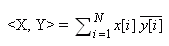
What
is the purpose of taking complex conjugates of components
of Y?
Inner product of a vector with itself must be non-negative
by definition as any vector is wholly contained in itself.
If X
is any complex vector this condition requires complement
of Y
to be taken in the above definition.
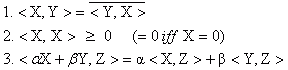
Conditions
for a function to be an inner product in a vector space:
An operation <X,
Y> between two vectors
X
and Y
can be called an inner product if and only if it satisfies
the following conditions:
Now
lets define the inner product for continuous and discrete
time as shown below. Clearly, each of these definitions
satisfies the necessary conditions for it to be described
as an inner product.
Continuous
Time: Consider X(t)
and Y(t)
as two signals in continuous time.
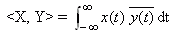
Provided
the integral exists
Discrete
Time: Consider X[n]
and Y[n]
as two signals in discrete time.
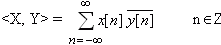
Compare
this with the definition of dot product for two finite
dimensional vectors
|


