|
How it works?
In practice, analog signals are sampled using zero - order - hold (ZOH) devices that hold a sample value constant until the next sample is acquired. This is also called as
flat - top sampling. This operation is equivalent to ideal sampling followed by a system whose impulse response is a pulse of unit height and duration
Ts ( to stretch the incoming pulses ). This is illustrated in Figure below :
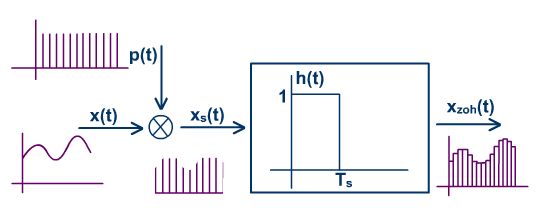
Reconstruction of signal in Zero Order Hold Filter
The analog Signal (continuous - time signal) is multiplied with a periodic impulse train, referred to as Sampling Function. A sampled signal is then obtained as shown in figure below.
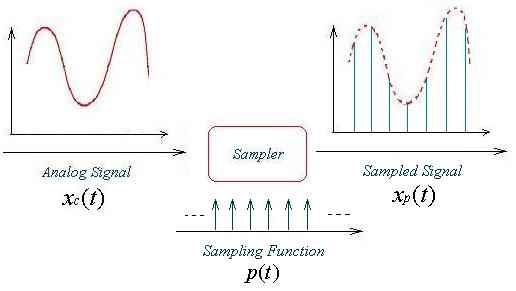
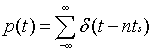
The ideally sampled signal xp(t) is the product of the impulse train
p(t) and the analog signal xc(t) and is written as

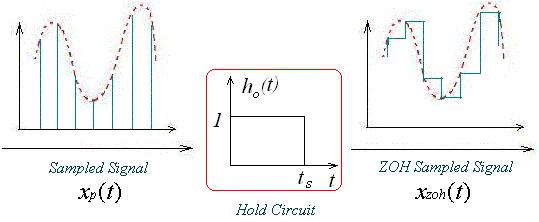
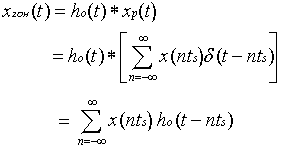
The ZOH Sampled Signal xZOH(t) can be regarded as the convolution of
ho(t) and a sampled signal xp(t)
|


