|
The impulse response of the ideal low pass filter extends
to .
If the impulse response is denoted by h(t), the output
signal y(t) corresponding to input signal x(t) is given
by : .
If the impulse response is denoted by h(t), the output
signal y(t) corresponding to input signal x(t) is given
by :
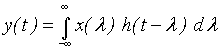
The value of y at any t depends on values of
x all the way to  if
h(t) extends to . Thus realization in real time is not possible for an Ideal low-pass filter. In other words, unless one knows the entire if
h(t) extends to . Thus realization in real time is not possible for an Ideal low-pass filter. In other words, unless one knows the entire  , reconstruction cannot be done. , reconstruction cannot be done.
Note if h(t) had been finitely non-causal (say zero
for all t less than some -  ),
then real time realization would have been possible
subject to a time-delay (of ). ),
then real time realization would have been possible
subject to a time-delay (of ).
|


 diverges.


