2.Linearity
Both the Fourier transform and its inverse system are linear. Thus the Fourier transform of a linear combination of two signals is the same linear combination of their respective transforms. The same, of-course holds for the Inverse Fourier transform as well.
3.Memory
The independent variable for the input and output signals in these systems is not the same, so technically we can't talk of memory with respect to the Fourier transform and its inverse. But what we can ask is: if one changes a time signal locally, will only some corresponding local part of the transform change? Not quite.
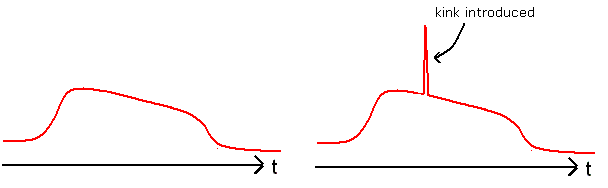
Introducing a local kink like in the above time-signal causes a large, spread-out distortion of the spectrum. In fact, the
more local the kink, the more spread-out the distortion!
By duality,one can say the same about the inverse Fourier transform.
I.e: if x(.) has a Fourier transform
X(.), using Duality and the above discussion, we can say that introducing a local distortion in
X(.) will cause a “wide-spread” distortion in x(-.). But x(.) is also the inverse Fourier transform of this locally changed
X(.). Thus introducing a local kink in the spectrum of a signal changes it drastically.  |


