where a0 is the Bohr radius of Hydrogen atom, ε0 is the dielectric constant of vacuum, μ is the electron-hole reduced mass, and Δx is the exchange splitting of the exciton ground state. For a semiconductor with degenerate concentration of holes, the result is
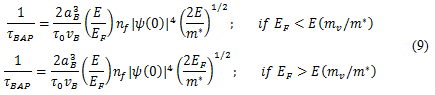
where Ef is the Fermi energy and mv is the relevant hole effective mass.
(iv) Hyperfine interactions with nuclear spins:
In solids, the nuclear spins generate an effective magnetic field which interacts with the electron spins via hyperfine interactions, resulting in spin relaxation. The Hamiltonian describing this interaction is given by
..........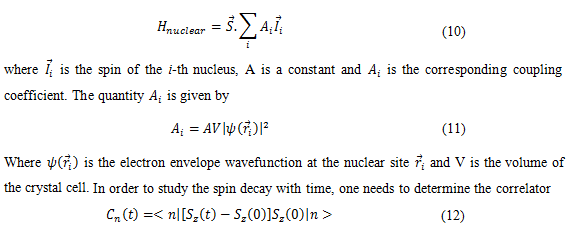
where |n> is the coupled electron and nuclear site, Sz(0) and Sz(t) are the initial spin eigenstate at time t=0 and the Eigenstate at some later time t, respectively, and Sz(t) is given by  . From the behavior of Cn(t), one can deduce the temporal behavior of Sz(t). The decay is much faster for the fully polarized case, but the steady state value <Sz(∞)> is much closer to Sz(0) in the fully polarized case that in the unpolarized case. In any case, the hyperfine interaction does not cause complete loss of electron spin polarization.