Magnetic hysteresis loops for recording:
Figure 35.1 shows the M-H loops measured along the two directions of the thin film samples: perpendicular to the film plane (blue curve) and parallel to the film plane (red). It is clear from the figure 35.1a that the magnetic loop measured under perpendicular direction exhibited a clear almost square shaped loop, while the loop measured in the film direction showed almost a linear variation with the field up to 15 kOe field and then saturates at higher fields. These results reveal that the film has magnetization easy-axis perpendicular to the film plane and hard axis exists along the film plane. If the easy-axis orientation is not perfect along the perpendicular direction, then the magnetization measured along the hard axis direction depicts a definite hysteresis as shown in Figure 35.1b. Such behaviours are correlated to the crystal structure and microstructural properties of the films. Therefore, the optimization of the magnetic properties of the films with respect to the fabrication conditions is very much essential.
|
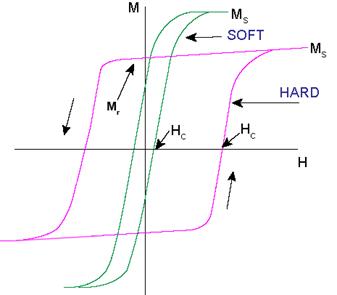
Figure 35.2: Typical M-H loops of a hard and soft magnetic material. |
Coercivity:
In materials science, the coercivity (also called as coercive field or coercive force) of a ferromagnetic materials is the intensity of the externally applied field required to reduce the materials' magnetization to be zero (see Figure 35.2) after the magnetization of the samples has been driven to saturation in either of the directions. Hence, the coercivity generally measures the resistance of a ferromagnetic material to becoming demagnetized.
Magnetic materials with the coercivity less than 10 Oe are usually called as soft magnetic materials, while those with larger than 100 Oe are called hard magnetic materials (see Figure 35.2). Note that the coercivity is not affected by the demagnetization because the magnetization is zero at the coercivity point. Hence, the materials with high coercivity are used naturally as magnetic recording media since their high value of coercivity prevents the material from demagnetization if the demagnetization field is smaller than the coercivity. The shape of the M-H loop is often specified by the remanence squareness ( S ), defined as the ratio of the magnetization at the zero applied field after the magnetization of the sample has been driven to saturation to the saturation magnetization of the sample, and the coercive squareness ( S *). The value of S* is correlated to the coercivity through the following relation as given in eqn.(35.1).
|
(35.1) |
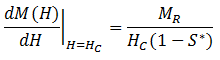
where MR is the remanence as given in Figure 35.1. When S* approaches to 1, the shape of the hysteresis loop turns out to be perfect square.