Objectives:
In the earlier lectures, we have covered the discussion on recording and readback theories, aspects of various types of magnetic recording head. Another important part of the magnetic recording is the media, as it contains all the recorded information. Although there are lot of components in the disk to function properly, it is no wonder that many refer to a magnetic disk drive simply as a magnetic disk. Note that a magnetic media is composed of either closely packed magnetic particles, continuous magnetic thin films deposited on a substrate, or artificially designed nanostructure for recording the information. Hence, they are called as particulate, thin-film disks, and patterning media, respectively. As the magnetic recording media is one of the core parts of the magnetic disk, it is important to understand various requirements for a material to act as a medium, availability of different types of media and their functionality for recording and storing the digital information. Hence in this module, our primary motivation is to provide detailed information on
1. Magnetic recording media and its requirement,
2. Various types of media (Particulate, thin films and pattern media),
3. Properties of the medium,
4. Perpendicular recording,
5. High density recording, and
6. Future projections on ultrahigh density magnetic recording.
Magnetic recording media:
Magnetic disks are generally classified as flexible disks or floppy disk and hard disk based on the types of substrates used. The first types commonly use the polyester substrates suitable for removable disk storage. For example, 1.4 MB floppy disk and zip disk. Hard disks usually use Al-Mg based light weight substrates, glass, and ceramic substrates. Since they are rigid, it allows higher rotation speed, reduced magnetic spacing, and accommodates high linear data and track densities.
Rigid disk drives and disks have shrunk in size over the years. The first rigid disks, manufactured in 1957, were 24 inch in diameter. Later up to 1970, 14 inch diameter disks with a thickness of 0.075 inch dominated the industry. The sizes were rapidly decreased during the 1980s. The late 1980s saw the 95 mm diameter (3.5 inch) disks with 0.8 mm thickness, which dominates the disk volumes of this day. 48 mm disks were emerged out in late 1990s. Different sizes of the disks were produced over a last decade suitable for various consumer electronics. The magnetic disks were classified according to their form factor as listed in Table 31.1 [1].
Table 31.1 : Form factor of the magnetic disks.
Form Factor (in.) |
24 |
14 |
8 |
5.25 |
3.5 |
2.5 |
1.8 |
1.3 |
Diameter (mm) |
606 |
355 |
210 |
130 |
95 |
65 |
48 |
33 |
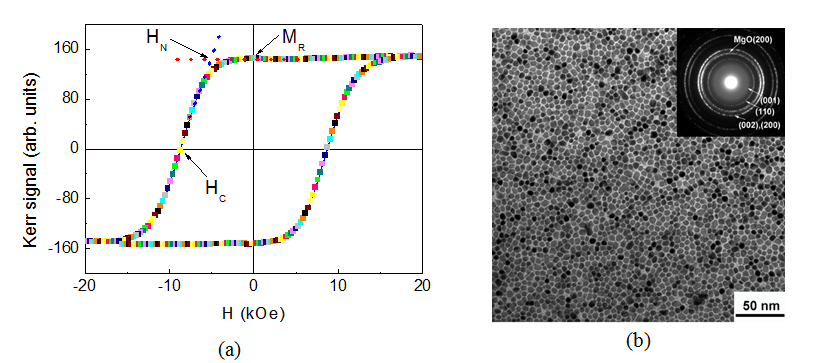
Figure 31.1: (a) Typical magnetic hysteresis (M-H) loop and (b) nanogranular microstructure of a material suitable for magnetic recording application [2]. |