Soft and Hard magnetic materials:
Ferromagnetic materials are basically divided into two broad classes: Soft magnetic materials and hard magnetic materials. Figure 5.1 depicts a typical magnetic hysteresis loop of ferromagnetic materials, when they are placed under an external magnetic field. The area under the hysteresis loops mainly help to quantify them as hard or soft magnetic materials.
Figure 5.1: Typical magnetic hysteresis loop of a ferromagnetic material. |

Figure 5.2: Typical magnetic hysteresis loops of soft and hard ferromagnetic materials. |
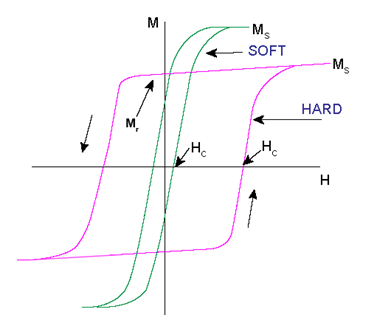
Figure 5.2 displays comparative magnetic hysteresis loops for both soft and hard magnetic materials. Hard magnetic materials generally show low initial permeability (close to the origin in Fig.5.1) and high coercive force ( HC >1000 Oe). These materials are generally used for disk media or for a permanent magnet application. On the other hand, soft magnetic materials exhibit high initial permeability and also low coercivity (<100 Oe). These materials are used for a transformer or a magnetic head application. Since both the types of ferromagnetic materials have different magnetic parameters associated with the hysteresis, their magnetization reversal behaviour would also be different. Now, we shall try to understand the magnetization reversal behaviour using Stoner-Wohlfarth (SW) model.