Induced Anisotropy:
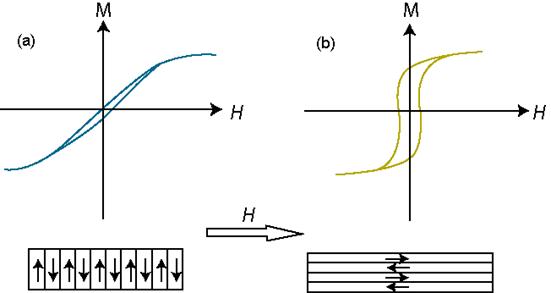
In some materials, the magnetic anisotropy can be induced by many ways: (i) fabricate a film in the presence of a magnetic field, (ii) heat treat the materials in the presence of external applied magnetic field, and (iii) apply uniaxial stress. In the first two cases, after such treatment, the material may exhibit an easy axis of magnetization that points in the direction of the magnetic field that was applied. This induced anisotropy is certainly independent of any crystalline anisotropy or any other form of anisotropy that might be present. Figure 4.2 shows the typical example of inducing the anisotropy in the ferromagnetic materials by field annealing. One of the classical materials that exhibits the magnetic field induced anisotropy is Permalloy. If there are no stray magnetic fields present during deposition, then the easy axis of anisotropy will be found to be in the direction of the earth's magnetic field.
Figure 4.2: Magnetization of a thin film with induced anisotropy created by annealing in a magnetic field. The sheared (open) loop in a (b) is observed when the measuring field H is applied perpendicular (parallel) to the annealing field direction. |
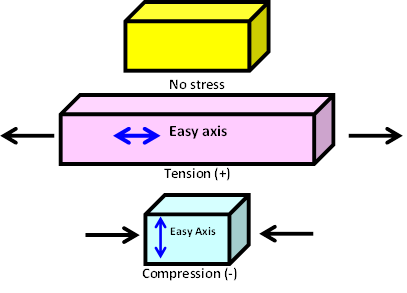
In the last case, the uniaxial anisotropy is induced by applying uniaxial stress in a ferromagnetic solid. The magnitude of the stress-induced anisotropy is
|
(4.3) |

where λS is the saturation magnetostriction. Both the single-ion and two-ion anisotropy contribute to the stress induced anisotropy. The largest values of uniaxial anisotropy are found in hexagonal and other uniaxial crystals. Smallest values are found in cubic alloys and amorphous ferromagnets.
Figure 4.3: Schematic drawing of bars to demonstrate the inducing an easy-axis in a material with the positive magnetostriction. |