4. Landau theory of phase transition
In the previous sections, mean field (MF) theory was discussed considering different models. It was observed that MF not only can reproduce the experimentally observed behavior at the critical point but also the critical behavior is found independent of the detailed features of the models. It is therefore natural to have a simple theory without involving detailed interactions in it but should be good enough to describe critical phenomena. Since thermodynamic potential can provide information about thermodynamic quantities, Landau developed a simple theory for critical phenomena guessing the form of the thermodynamic potential.
4.1. Landau potential:
The Landau potential  should be such that its minima with respect to m should describe the thermodynamic properties of the system at
  . Since the free energy usually obtained as a function of the intrinsic variables such as T and h and one may be tempted to consider the Landau potential as
  . Since the free energy contains most of the information about the critical singularity, the free energy can be represented as a Taylor series expansion around the critical point
  . However, at the critical point, the magnetization
 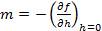 is a multivalued function for
  . The isothermal susceptibility
 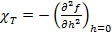 tends to infinity as
  . Therefore, such an expansion is going to be highly singular because the derivatives appearing in the Taylor series expansion are singular. Another form of the Landau potential
  can be obtained through a Legendre transformation

Now the first derivative  and the second derivative
  are either finite or zero as . Thus an expansion in m is possible.
The structure of Landau potential 
(i) Should be analytic,
(ii) Should have the same symmetry of the Hamiltonian. That is  and hence an even function.
(iii) For 
 . For ,
  and two phases co-exists.