1. Introduction:
In this chapter some of the fundamental models developed for studying interacting systems will be described. These models are spin-1/2 Ising model, spin-1 Ising model, q-state Potts model, XY-model, Heisenberg model and n-vector model. In these models of interacting systems, the details of all possible complicated many body interactions are not taken into account. Rather, interactions are included in a simplest possible way such that the models could be solved exactly either analytically or numerically and the essential physics of an interacting system can be understood. We will be using the magnetic language and write down the Hamiltonian in terms of spin variables. However, they will be applicable to non-magnetic systems also. The models will be described on one, two or three dimensional regular lattices. The spin variables will be assigned to the lattice sites of a given lattice.
2. Spin-1/2 Ising Model:
A classical spin variable  , which takes +1 or -1 values corresponding to the states up or down, placed on each lattice site. Usually, the interaction among the spins is limited (however, not restricted) to the nearest neighbor spins only. The interaction energy or the exchange energy among two spins is given by J. The Hamiltonian for such an interacting system is given by
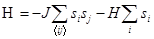
where H is external magnetic field in units of energy and  represents the nearest neighbor interaction. The first term in the Hamiltonian is responsible for the cooperative behavior. For j=0 , the Hamiltonian corresponds to a paramagnetic system.
Ground state configuration: First we set the external field H=0 and then the Hamiltonian is given by

Consider two spins only along a one dimensional chain. Since the spins have two states each, there are total  configurations possible.