


Next: Ledge growth of facetted Up: Module 4. Growth of Previous: Interface structure and growth
Consider, for example, the growth of a platelike precipitate with coherent facetted faces and incoherent edges. In such a case, it is possible that the thickness of the plate would remain constant while the cylindrically curved edge would grow. In Fig. 26 we show the growth of such a precipitate along with the composition profile. One important change in the composition profile as compared to the one in Fig. 22 is that the composition on the matrix side is not the equilibrium composition given by the phase diagram but is elevated due to Gibbs-Thomson effect.
| [scale=0.4]Figures/PlatePptGro.pdf |
In this case also, an equation similar to Eq. 51 holds (with the composition
on the  side of the interface corrected for Gibbs-Thomson):
 |
(10) |
As earlier, assuming equal molar volumes for both the phases, it can be shown that
 |
(11) |
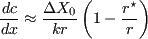 is a cosntant of order unity and
  is the radius of
critical nucleus, that is, the radius for which
is the radius of
critical nucleus, that is, the radius for which  is reduced to zero.
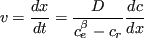
Thus, we get, for the plate/needle lengthening velocity as
is reduced to zero.
Thus, we get, for the plate/needle lengthening velocity as
An important consequence of such an expression as above is that the diffusion limited
plate lengthening rate, for a given thickness of the plate, is a constant; that is,  ;
in other words, the rate of growth is linear.
;
in other words, the rate of growth is linear.
Guest 2013-07-05
