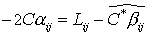
In addition to the above-mentioned local averaging, we perform a modification of Equation (34.9) as suggested by Piomelli and Liu (1995). Mathematically Equation (34.9) is in consistent if C ceases to be a function of space (Piomelli and Liu, (1995)). Ghosal et al. (1995) developed a consistent procedure without making use of the least square approach. It is necessary to perform an iterative solution of an integral equation for calculating C by this procedure. Computational effort associated with the iterative solution is significantly high. Piomelli and Liu (1995) have suggested a simpler approach based on modification of Equation (34.6) as
 |
(34.12) |
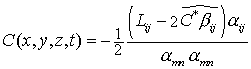
On the right-hand-side, C * substitutes the coefficient C . The value of C * is assumed to be known. In the event, minimization of the sum of the square results
 |
(34.13) |
where
 |
(34.14) |
This is the equation for calculating the model coefficient C . There are various ways to obtain C at time step n . Piomelli and Liu (1995) indicates that there is no significant difference between zeroth and first order approximation for estimating C* . The present computation uses zeroth-order approximation through the value at the previous time step
 |
(34.15) |
Eventhough we have used the local averaging procedure of Zang et al. (1993) spurious values of C appeared during the calculation. After averaging, following additional constraint was necessary
 |
(34.16) |
This restriction is necessary to avoid negative turbulent viscosity (Ghosal et al. (1995)).
|