The major contribution to the subgrid scale model brought about by Germano et al. (1991) is the identification that consistency between (34.1) and (34.2) depends on a proper choice of C . This is achieved by subtraction of the test-scale average of  from Tij (Lilly, 1992; Hoffmann and Benocci, 1994) to obtain from Tij (Lilly, 1992; Hoffmann and Benocci, 1994) to obtain
 |
(34.6) |
with
 |
(34.7) |
and
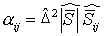 |
(34.8) |
Equations (34.1), (34.3), (34.6), (34.7) and (34.8) are five independent equations which cannot be solved for the model constant C because It appears in a filter operation (Equation (34.6)). Lilly (1992) and Zang et al. (1993) suggested the following assumption
 |
(34.9) |
This enables Equation (34.6) to be written in the form
 |
(34.10) |
Eij is the residue of Equation (34.10). Application of the least square technique to minimize the residual gives the following expression for C
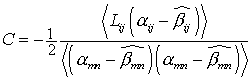 |
(34.11) |
Here <.> means average over a plane in the model for which the flow is homogeneous. The least square minimization technique has been used by Piomelli (1993) to compute the flow in a plane channel at Reynolds numbers based on friction velocity and channel half width in the range between 200 and 2000. A limitation of the dynamic model is the plane averaging mentioned earlier. For an essentially three-dimensional flow like the rectangular impinging jet, there is no homogeneous space direction. Hence, instead of a plane averaging, we propose to use a local averaging over the test filter cell. Zang et al. (1993) performed this local averaging and also constrained the effective viscosity (molecular and eddy viscosity) to be non-negative for recirculating flows.
|