The RNG model is reliable for a wider class of flows than the standard k - ε model. However, the accuracy for predicting the turbulent flows using the RNG model is reported as poorer than that for other k - ε models for vortex shedding behind the bluff objects, such as square rods and circular tubes in a heat exchanger. In these cases, the separated flows are not well predicted as in chevron or corrugated plate geometry. Such vortex shedding has low frequency modulations. Saha et al. (1999) compared three turbulence models to capture the essence of time-averaged flow quantities in a vortex shedding dominated flow field through the turbulence models in two dimensions. They used the Launder and Spalding (1974) standard k - ε model, the Kato-Launder k - ε model (1993), and the RNG k - ε model of Yakhot et al. (1992). In terms of the parameters such as Strouhal number and lift and drag coefficients, the predictions due to the Kato-Launder and the standard k - e models were close to each other, and reasonably close to experiments of Lyn et al. (1995). However, the predictions due to RNG k - ε models were not close to the experiments values. A detailed comparison of velocity profiles revealed the Kato-Launder model to have the closest agreement with the experiments. A comparison between the computations and the experiments were also made for the time averaged kinetic energy variation along the centerline of the domain of interest. The Kato-Launder model predicted the peak value of turbulent kinetic energy in good agreement with the experiments. The peak value of the turbulent kinetic energy due to the RNG k – ε model showed a significant departure from the experimental value. It was also revealed that the Kato-Launder model retains a good correlation between the kinetic energy (Figure 31.2) and vorticity fields through correctly estimated production terms. Thus, the comparison of these turbulence models indicates that the accuracy of the models may depend upon the geometry investigated; a more thorough investigation is needed for establishing the utility of specific models for specific geometries.
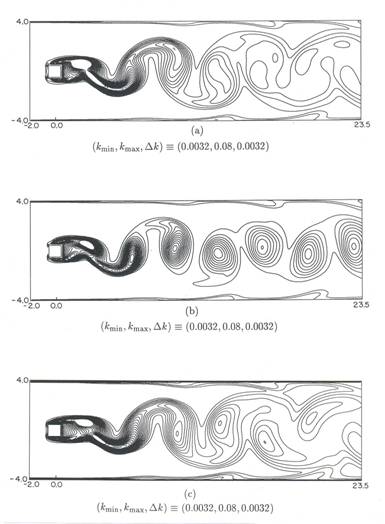
Figure 31.2: Instantenous turbulent kinetic energy contours (a) standard k - ε (b) Kato-Launder k - ε and (c) RNG k - ε .
|