In standard k - ε model high generation rates are predicted in the regions of high strain rate or streamline curvature (Launder and Spalding, 1974). This excess of turbulence energy creates high level of turbulent viscosity. The high turbulent viscosity tends to over predict mixing and delay separation . Kato-Launder modified k - ε (Kato and Launder, 1993) model provides a remedy of this problem.
Two different high Reynolds number versions of the two-equations model that have been used in the present text are (i) RNG k - ε and (ii) Kato-Launder models. Both the model relate the turbulent viscosity v t to the turbulent kinetic energy k and its rate of dissipation ε. In the standard k - εmodel, the transport equations for k and ε are
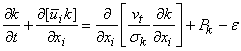
|
(31.1) |
 |
(31.2) |
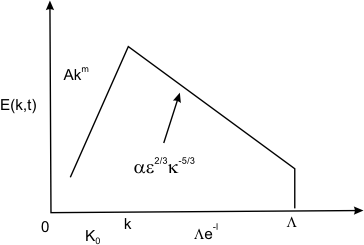
Figure 31.1: Scales of Effective Excitation in Turbulence
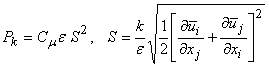
where the production term is
 |
(31.3) |
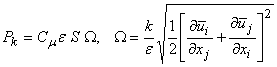
The KaLa model is similar to the standard k- ε , except that the turbulence production term in Equation (31.3) is replaced by
 |
(31.4) |
The quantity Ω is related to the average rotation of a fluid element. In the simple shear flow context, S and Ω are equal. However, in stagnation flows, Ω =0 and S > 0. This leads to the desired reduction of the production of kinetic energy near the forward stagnation point of the bluff objects. This has an important effect of lowering eddy viscosity in the boundary-layers and permits vortices to be shed from the rear side. In the RNG k- ε model, Pk is given by Equation (31.3) and Equation (31.2) is augmented on the right hand side by an extra strain-rate term R given by
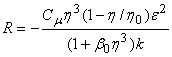 |
(31.5) |
where the quantity η is given by
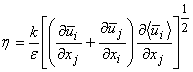 |
(31.6) |
The eddy viscosity νt for the standard k- ε and KaLa models is determined from the expression
 |
(31.7) |
Table 31.1: Model Parameters
Models |
Cμ
|
Cε1 |
C ε2 |
σk |
σε |
β0 |
η 0 |
Standard k - ε and KaLa |
0.09 |
1.44 |
1.92 |
1.0 |
1.3 |
- |
- |
RNG k - e |
0.0845 |
1.42 |
1.68 |
0.7179 |
0.0179 |
0.012 |
4.38 |
For the RNG k- ε , the eddy viscosity expression is
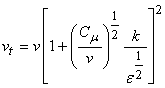 |
(31.8) |
The parameters for each of the above models appearing in Equations (31.1) - (31.8) are given in Table 31.1.
The RNG theory and its application to turbulence are described by Yakhot and Orszag (1986). The scale elimination procedure in the RNG theory results in a differential equation for turbulent viscosity, which is integrated to obtain an accurate description of how the effective turbulent transport varies with the effective Reynolds number and near-wall flows. In the high Reynolds number limit, the expression of turbulent viscosity is the same as in the standard k - ε model.
|