Module 8 :
Lecture 30 : Low Reynolds number k - ε model


Damping Functions

Most of the low Re version of k- ε models use three different damping functions, (i) fμ to damp Cμ, from 0.09 in fully turbulent flow to zero at the wall; (ii) the function f1 to enhance the near wall dissipation whereas the contribution of f1 should damp down as the distance from wall increases; and (iii) the function f2 to be multiplied to the destruction term of ε in order to incorporate the low Re effects on the decay of isotropic turbulence.

Table 30.1: Functions and Extra Terms for the Low Re Turbulence Models

Models

f μ

f1

f 2

Standard

1.0

1.0

1.0

JL

1.0

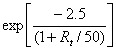
1 - 0.3 exp ( )

LS

1.0

1 - 0.3 exp ( )


CH

1 - exp (- 0.0115y+ )

1.0

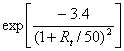
1 - 0.22 exp [ ]

LB

[1 - exp(- 0.165 Rk )] 2

´ (1 + 20.5/ Rt )

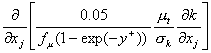
1 + [0.05/ fμ ] 3

1 - exp ( )

SM

1 − exp ( - a1 y+ - a2 y+2

− a 3 y +3 – a 4 y +4 )

1.0

1 − 0.22 exp [ ]

NH

1 − exp (- y+ /26.5) 2

1.0

1 − 0.3 exp ( )


Table 30.2

Models

Π

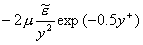
D

E

Standard

0

0

0

JL

0


LS

0


CH

0

LB

0

0

0

SM

0


NH

0


Table 30.3

Models

C μ

C1

C2

σ k

σ ε

Standard k - ε Model

0.09

1.44

1.92

1.0

1.3

(JL) Jones and Launder, 1972

0.09

1.0

2.00

1.0

1.3

(LS) Launder and Sharma, 1974

0.09

1.44

1.92

1.0

1.3

(CH) Chien, 1982

0.09

1.35

1.8

1.0

1.3

(LB) Lam and Bremhorst, 1981

0.09

1.44

1.92

1.0

1.3

(SM) Shih and Mansour, 1990

0.09

1.45

2.00

1.3

1.3

(NH) Nagano and Hishida, 1987

0.09

1.45

1.90

1.0

1.3


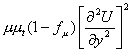
Further, such definition of new also gives rise to an extra term E in the equation to retain the validity of these equations in the laminar regime too. Only the Lam-Bremhorst (1981) model uses the original definition of ε and hence contains no extra terms D or E in the k and ε equation. Accordingly the appropriate boundary conditions at the surface for most of the models are:

(30.6)

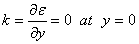
For the Lam- Bremhorst model however the boundary conditions are:

(30.7)