Continuity and Momentum Equations
The equations describing fluid flow emerge from the conservation laws for mass, momentum and energy. In this section, the equations for the conservation of mass and momentum are discussed. The scalar equation for energy transport will be discussed in a section presented later.
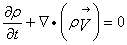
Continuity Equation (Conservation of mass):
 |
(37.1) |
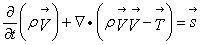
Momentum Equation (Conservation of momentum):
 |
(37.2) |
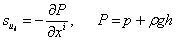
Here ρ is the mass density,  is the velocity field, is the velocity field,  is the diffusion flux vector (or surface traction) and is the diffusion flux vector (or surface traction) and  is the source vector from conservative forces (emerging from pressure gradients and gravity). In Cartesian co-ordinates ( x1, x2, x3 ) with orthonormal basis vectors i , j and k, the vectors , and can be expressed as, is the source vector from conservative forces (emerging from pressure gradients and gravity). In Cartesian co-ordinates ( x1, x2, x3 ) with orthonormal basis vectors i , j and k, the vectors , and can be expressed as,
Here
 (with j as dummy index, j =1,2,3) (with j as dummy index, j =1,2,3) |
(37.3) |
and
 |
(37.4) |
Physically, σi is the i-th component (i =1,2,3) of the diffusion flux vector (or surface traction) at a point on the surface of local unit normal  of the infinitesimal element, and of the infinitesimal element, and  represents the stress tensor component acting on the j-th plane in the i-th direction. The source vector represents the stress tensor component acting on the j-th plane in the i-th direction. The source vector  can be interpreted as a conservative force arising out of the absolute pressure gradients (in which gravity effects are included), and P represents absolute pressure. can be interpreted as a conservative force arising out of the absolute pressure gradients (in which gravity effects are included), and P represents absolute pressure.
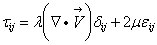
For any continuum where net distributive moments are absent, the stress tensor is symmetric (  = =  ). For a Newtonian fluid, the stress tensor components are given by ). For a Newtonian fluid, the stress tensor components are given by
 |
(37.5) |
where  is the Kronecker delta, ( =1 for i= j, and 0 for i ≠j ), μ is the molecular viscosity and λ is the Bulk viscosity, conventionally given by is the Kronecker delta, ( =1 for i= j, and 0 for i ≠j ), μ is the molecular viscosity and λ is the Bulk viscosity, conventionally given by  . The term . The term  represents the component of the strain rate tensor, given by represents the component of the strain rate tensor, given by
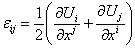 |
(37.6) |
For incompressible fluid flow,  . Hence for incompressible flow of a Newtonian fluid, the stress tensor components can be expressed as . Hence for incompressible flow of a Newtonian fluid, the stress tensor components can be expressed as
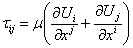 |
(37.7) |
The continuity equation is a scalar equation, and can be expanded in the Cartesian system of co-ordinates ( x1 = x, x2 = y, x3 = z ) into a single equation
 |
(37.8) |
The momentum equation is a vector equation, and therefore is expandable into three independent equations,
 |
(37.9a) |
 |
(37.9b) |
 |
(37.9c) |
|