In this section we will study the application of various pneumatic components in designing a pneumatic circuit. The graphical symbols of pneumatic components and equipments have already been discussed in lecture 7 of module 5.
1. Case study A
Consider a simple operation where a double-acting cylinder is used to transfer parts from a magazine. The cylinder is to be advanced either by operating a push button or by a foot pedal. Once the cylinder is fully advanced, it is to be retracted to its initial position. A 3/2-way roller lever valve is to be used to detect the full extension of the cylinder. Design a pneumatic circuit for the above-mentioned application.
1.1 Components used
The pneumatic components which can be used to implement the mentioned task are as follows:
- double acting cylinder
- 3/2 push button valve
- 3/2 roller valve
- shuttle valve
- 3/2 foot pedal actuated valve
- 5/3 pneumatic actuated direction control valve
- compressed air source and connecting piping
1.2 Working
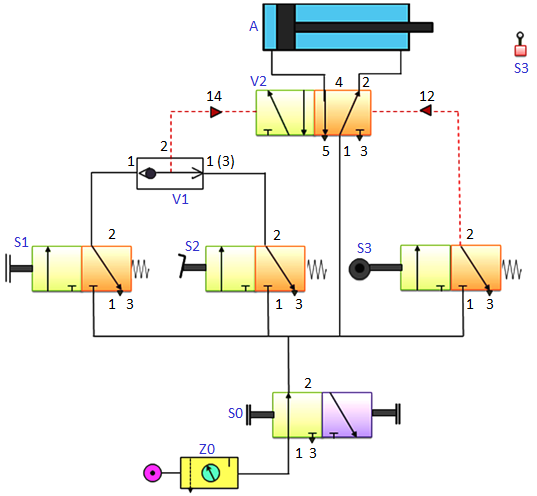
Fig. 6.6.1 Pneumatic circuit for shuttle valve operation
Figure 6.6.1 shows the proposed circuit diagram. As the problem stated, upon actuation of either the push button of valve (S1) or the foot pedal valve (S2), a signal is generated at 1 or 1(3) side of the shuttle valve. The OR condition is met and the signal is passed to the control port 14 of the direction control valve (V2). Due to this signal, the left position of V2 is actuated and the flow of air starts. Pressure is applied on the piston side of the cylinder (A) and the cylinder extends. If the push button or pedal valve is released, the signal at the direction control valve (V2) port is reset. Since DCV (V2) is a double pilot valve, it has a memory function which doesn't allow switching of positions. As the piston reaches the rod end position, the roller valve (S3) is actuated and a signal is applied to port 12 of the DCV (V2). This causes actuation of right side of DCV (V2). Due to this actuation, the flow enters at the rod-end side of the cylinder, which pushes the piston towards left and thus the cylinder retracts.