1. Diaphragm compressor
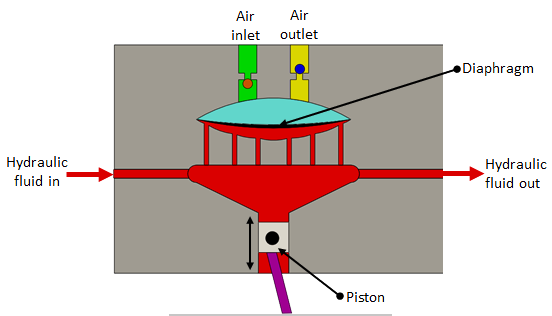
Fig. 6.2.1 Diaphragm compressor
These are small capacity compressors. In piston compressors the lubricating oil from the pistons walls may contaminate the compressed air. The contamination is undesirable in food, pharmaceutical and chemical industries. For such applications diaphragm type compressor can be used. Figure 6.2.1 shows the construction of Diaphragm compressor. The piston reciprocates by a motor driven crankshaft. As the piston moves down it pulls the hydraulic fluid down causing the diaphragm to move along and the air is sucked in. When the piston moves up the fluid pushes the diaphragm up causing the ejection of air from the outlet port. Since the flexible diaphragm is placed in between the piston and the air no contamination takes place.
2. Screw compressor
Piston compressors are used when high pressures and relatively low volume of air is needed. The system is complex as it has many moving parts. For medium flow and pressure applications, screw compressor can be used. It is simple in construction with less number of moving parts. The air delivered is steady with no pressure pulsation. It has two meshing screws. The air from the inlet is trapped between the meshing screws and is compressed. The contact between the two meshing surface is minimum, hence no cooling is required. These systems are quite in operation compared to piston type. The screws are synchronized by using external timing gears.
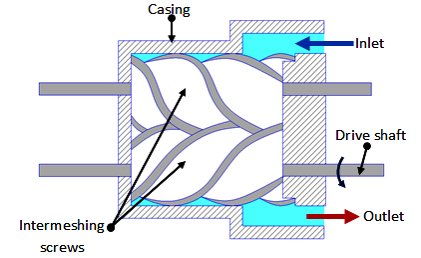
Fig. 6.2.2 Screw compressor