(i) Leakage Error :
In FFT or DFT, computations are based on the assumption that the data sampled over a time period are repeated before and after data measurement. Figure 11.28 shows the assumed signals and their spectra for two types of measurement of a sinusoidal signal  Both cases have 32 sampled data, but their sampling intervals are different. In case A, the sampling interval is
 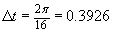 and the range measured is exactly twice the fundamental period. The computation of FFT or DFT is performed for the wave as shown by the dotted line. In this case the assumed wave is same as the original signal and therefore we get a correct signal spectrum. In case B, the sampling interval is
 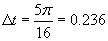 and the range measured is about 2.5 times the period of the original signal. In this case, the assumed wave shown in Figure 11.28(c) is not smooth at the junction and differs fro the original signal in time domain. As a result, the magnitude of the correct spectrum decreases and spectra that do not exist in the original signal appear. As seen in this example, if the time duration measured and the period of the original signal do not coincide, the magnitude of the correct spectrum decreases and spectra that do not exist in the original signal appear on both sides of the correct spectrum. This phenomenon is called the leakage error.