The vast computational task necessary for DFT prevented its practical utilization. In 1965, Cooley and Tukey proposed an algorithm that enabled the fast computation of DFT. The algorithm is called Fast Fourier Transform (FFT), has made real-time spectrum analysis a practical tool. In the calculation of DFT given by equation (16), we must perform many multiplications and additions.
However, the same calculation appears repeatedly since the function
 has a periodic characteristic.
The FFT algorithm eliminated such repetition and allowed the DFT to be computed with significantly fewer multiplications than direct evaluation of DFT. For further details refer to book by Newland (1991) “Random Vibration and Spectral Analysis”. The FFT algorithm has the restriction that the number of data must be
has a periodic characteristic.
The FFT algorithm eliminated such repetition and allowed the DFT to be computed with significantly fewer multiplications than direct evaluation of DFT. For further details refer to book by Newland (1991) “Random Vibration and Spectral Analysis”. The FFT algorithm has the restriction that the number of data must be 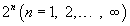 .
When the number of data N is
.
When the number of data N is  , DFT needs
  multiplications and FFT needs
  multiplications. For example, when, n=0, then N
 . Hence about 1,050,000 multiplications are necessary in DFT and about 20,480 in FFT. If N increases this difference increases extremely large. MATLAB has FFT function name
  where
where 