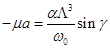
 ......................................................................................................... (6.6.20)
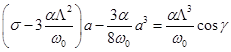 ........................................................................... (6.6.21)
Now eliminating γ from the above two equations, one can obtain a closed form equation which can be used for finding the frequency response of the system.
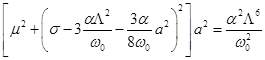 ................................................................... (6.6.22)
Solving Eq. (6.6.22) one may write the relation between the detuning parameter and amplitude of the response as follows.
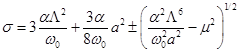 .........................................................................(6.6.23)
Hence, in this resonance condition, the free oscillation term does not decay to zero inspite of the presence of damping. Moreover, the nonlinearity adjusts the frequency of the free oscillation term to exactly three times the frequency of the excitations so that the response is periodic. Since the frequency of the free oscillation term is 3 times the frequency of excitation, such resonances are called super harmonic resonances or overtones.
From Eq. (6.6.20) the peak amplitude of the free oscillation term is given by
 ......................................................................................................................(6.6.24)
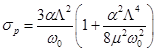 ............................................................................................. (6.6.25)
Subharmonic Resonance 
When the external frequency is nearly 3 times the natural frequency of the system, using detuning parameter one can write