36.1 Property relations
As we observed earlier, shock tube operates for a given driver and driven gas conditions. Hence the conditions or properties of the gas in the regions 1 and 4 are already know to us. However the properties of gas in region 2,3 are 5 are unknown and can be evalued from basic mass, momentum and energy conservation priciples. The measurable quantities in the experimental set up of shock tube can be used to evaluate these parameters. Therefore apart from thermodynamic properties of driver and driven gas, shock Mach number can be calculated using the pressure measurements in the experiments. The time taken by the shock wave to pass beween two pressure sensors mounted in the driven tube (shown in Fig.35.1) and the spacing between them gives the speed of the shock wave. Ratio of the shock wave speed and the driven section acustic speed is the shock Mach number.
Relations between region 1 and 2:
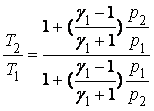
The jump relations to determine the state of region (2) behind the moving shock.
|
(35.1) |
|
(35.2) |
|
(35.3) |


Relations between region 2 and 3:
The region behind the contact surface is referred to as region (3). Although the temperature and the density could be different across the contact surface, the velocities and pressures at both sides of the contact surface must be equal, that is:
|
(35.4) |
|
(35.6) |


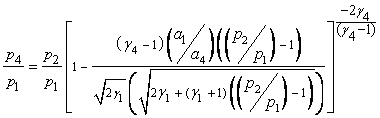
We can as well calculate the pressure rise or shock Mach number from the know driving pressure ratio of the shock tube.
|
(35.7) |
As we known that,
For monatomic gas
For diatomic gas 
For triatomic gas 
Therefore, it is clear from eq. 35. 7 that higher shock speed can be gained by using lighter driver gas. The same thing can be interpreted for  the above eqn can be approximated
by
the above eqn can be approximated
by
|
(3.1.11) |
|
(3.1.12) |


This proved that, light gas needs to be used to increase the strength of the primary shock. However incresed diver gas temperature along with the lighter gas can lead to enhanced primary shock strength.
Reflection of a shock wave from the shock tube end wall:
A shock
wave which is reflected from the end wall of the shock tube is then travels
upstream. Then it is desirable to know the conditions in region (5) behind the
reflected shock wave. The gas in this region is at rest, thus  . The reflected shock wave
travels into the oncoming flow whose velocity is
. The reflected shock wave
travels into the oncoming flow whose velocity is  . Thus the shock jump relations
are applied to the relations across the reflected shock wave and obtains
. Thus the shock jump relations
are applied to the relations across the reflected shock wave and obtains
|
(3.1.13) |
|
(3.1.14) |

