28.2. Velocity Potential Equation
We know that, if curl of any vector field is zero then the corresponding vector field can be represented by gradient of scaler as,


In view of the same, velocity field can be represnted by gradient of potential for the irrotationalitty condition.

However we know that,

and
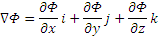
Therefore the components of velocities can be represented by corresponding potential gradients as,

The mass conservation equation for the steady state condition is,

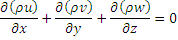
Replacing the components of velocities we get,
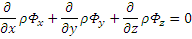
 --------------(28.2)
However we have already derived the irrotational form of the Euler equation which can be used to replace the density gradients of above equations,

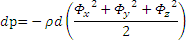 -----------------------(28.3)
The definition of sound speed leads to,
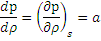

Replacing dp of above equation using Eq. 28.3 we get,
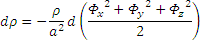
Hence, partial differentials of density are,
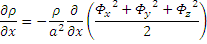



The partial derivatives of density can be used to simplify the Eq. 28.2 as,

---(28.4)
This equation is called as velocity potential equation. This equation is derived for steady irrotational flows from mass and momentum equations. This equation has two unknowns viz velocity potential and acustic speed or speed of sound. However the speed of sound seen in above equation can also be representd by velocity potential using enery equation. Lets consider that the total enthalpy is constant in the flowfield.

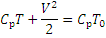
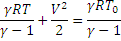
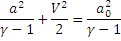

 ---- (28.5)
Simultanious solution of Equations 28.4 and 28.5 gives the velocity potential. Using this we can get the velocity field using the potential gradients. However direct solution of these equation is not possible. Hence linearisation of these equation is essential.