3.1 Conservation of Momentum (Integral Form)
Momentum equation is based on Newton's second law. This can be expressed as
|
(3.1) |

Consider the same CV shown in Fig. (2.1) for deriving the momentum conservation equation. Right hand side of equation (3.1) is the summation of all forces like surface forces and body forces. Let Fb and P be the net body force per unit mass and pressure exerted on control surface respectively. The body force on the elemental volume dυ is therefore
ρFbdv
and the total body force exerted on the fluid in the control volume is
|
(3.2) |

The elemental surface force due to pressure acting on the element of area ds is
-Pds
where the negative sign indicates that the force is in the direction opposite of ds. Therefore, total pressure force is the summation of the elemental forces over the entire control surface expressed as
|
(3.3) |

Let Fviscousbe the total viscous force exerted on the control surface. Hence, the resultant force experienced by the fluid as it is sweeping through the fixed control volume is given by the sum of total pressure force, body force and viscous force i.e,
|
(3.4) |
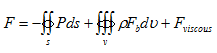
Consider the left side of the Equation (3.1). This term gives the time rate of change of momentum following a fixed fluid element or substantial derivative of the momentum. Hence we can evaluate this using equation (2.2). Therefore we will have to evaluate sum of net flow of momentum leaving the control volume through the control surface s (shown in Fig. (2.1)) and time rate of change of momentum due to fluctuations of flow properties inside the control volume.
The mass flow across the elemental area ds is (ρV.ds).Therefore, the flow of momentum per second across ds is
(ρV.ds)V
The net flow of momentum out of the control volume through s is the summation of the above elemental contributions, namely,
|
(3.5) |

The momentum of the fluid in the elemental volume dυ is (ρdu)V. The momentum contained at any instant inside the control volume is therefore

and its time rate of change due to unsteady flow fluctuation is
|
(3.6) |

Combining Equations (3.5) and (3.6) to obtain the left hand side of equation (3.1), we get
|
(3.7) |
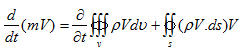
Thus, substituting Equations (3.4) and (3.7) into (3.1), we have
|
(3.8) |

This is the momentum equation in integral form. It is a general equation, applies to the unsteady, three-dimensional flow of any fluid, compressible or incompressible, viscous or inviscid.
3.2 One dimentional form of Momentum conservation Equation
For the steady and inviscid flow with no body forces, the Equation (3.8) reduces to
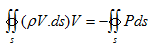
Above equation is a vector equation. However, since we are dealing with the one-dimensional flow, we need to consider only the scalar x component of equation.
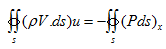
Considering the control volume shown in Fig (2.2), above equation transforms to,
ρ1(-u1A)u1 + ρ2(-u2A)u2 = -(-P1A + P2A)
or
|
(3.9) |

This is the momentum equation for steady inviscid one-dimensional flow.