To find the True shape of a plane surface
The true shape of plane surface when its top an front views are given may be determined by setting up two auxiliary planes and projecting on to these. The example below will demonstrate the method of finding the true shape of a quadrilateral.
Problem 4:The corners of a quadrilateral PQRS area as follows: P is 25 mm above HP and 50 mm in front of VP, Q is in HP and 80 mm in front of VP. R is 50 mm above HP and 40 mm in front of VP. S is 65 mm above HP and 20 mm in front of VP. The distances between the vertical projectors parallel to the XY lines are as follows: Between P and S is 20 mm, between P and Q is 35 mm, between P and R is 60 mm. Draw the top and front views of the quadrilateral and find its true shape.
Solution:
The method os obtaining the true shape of the lamina is shown in figure 4. First draw the front view and top view of the lamina as per the conditions mentioned in the problem. Through any one corner in any of the two view, say p in the top view, draw a line parallel to the XY line to intersect the edge qr at t. Project t to the top view to get t’ on q’r’. Connect p’t’. Since pt is horizontal, p’t’ is in true length. The point view of line p’t’ can be obtained by projecting on to an AIP (by drawing the reference line X1 Y1 perpendicular to p’ t’).
Project the four corner points to get the Auxiliary top view s1 r1 p1 q1 (line view). Project the auxiliary Front View on to another Auxiliary vertical plane by drawing the X2Y2 line, parallel to s1r1p1q1 line.
The Auxiliary Front view will be the true shape of the object.
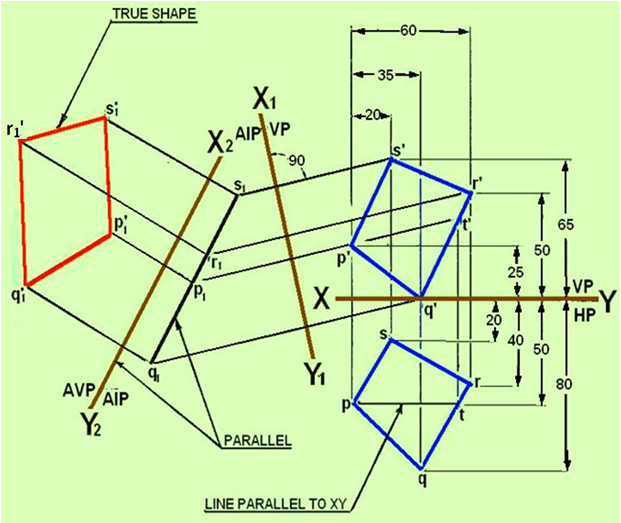
Figure 4. Solution of problem 4.