Projections of lines
Straight line
A line is a geometric primitive that has length and direction, but no thickness. Straight line is the Locus of a point, which moves linearly. Straight line is also the shortest distance between any two given points.
The location of a line in projection quadrants is described by specifying the distances of its end points from the VP, HP and PP. A line may be:
- Parallel to both the planes.
- Parallel to one plane and perpendicular to the other.
- Parallel to one plane and inclined to the other.
- Inclined to both the planes.
Projection of a line
The projection of a line can be obtained by projecting its end points on planes of projections and then connecting the points of projections. The projected length and inclination of a line, can be different compared to its true length and inclination.
Case 1. Line parallel to a plane
When a line is parallel to a plane, the projection of the line on to that plane will be its true length. The projection of line AB lying parallel to the Vertical plane (VP) is shown in figure 1 as a’b’.
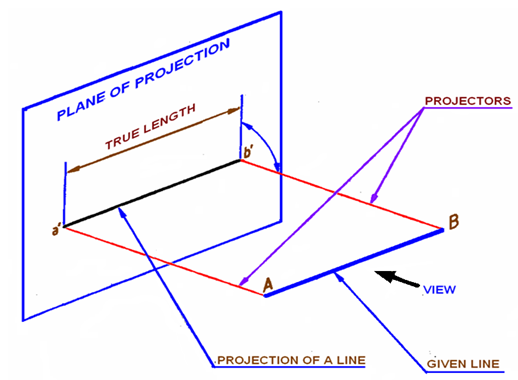
Figure 1. Projection of line on VP. Line AB is parallel to VP.
Case 2. Line inclined to a plane
When a line is parallel to one plane and inclined to the other, The projection of the line on the plane to which it is parallel will show its true length. The projected length on the plane to which it is inclined will always be shorter than the true length. In figure 2, the line AB is parallel to VP and is inclined to HP. The angle of inclination of AB with HP is being θ degrees. Projection of line AB on VP is a’b’ and is the true length of AB. The projection of line AB on HP is indicated as line ab. Length ab is shorter than the true length AB of the line.
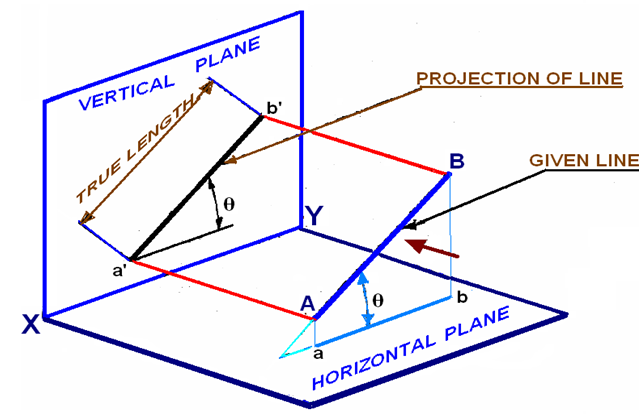
Figure 2. Projection of line AB parallel to VO and inclined to HP.