|
Trajectory tracking control: |
|
Feed forward. |
|
Computed torque |
|
Linear form with disturbance  Robot &
actuator Dynamics Robot &
actuator Dynamics |
| |
Here  is effective inertia which is assumed to be constant over a range of motion & is function of generalised co-ordinates. is effective inertia which is assumed to be constant over a range of motion & is function of generalised co-ordinates. |
| |
 - is constant damping term. - is constant damping term. |
|
 - disturbance term(which accounts for coriolis, centripetal, inertia & coupling forces. ) - disturbance term(which accounts for coriolis, centripetal, inertia & coupling forces. ) |
| |
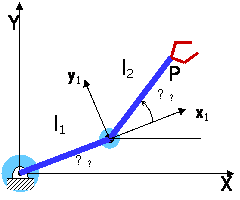
In Trajectory tracking problem we have to move end effector along predefined path. By using inverse kinematic analysis we can find out desired joint angles which are function of time. From these we can find out desired angles through which the motor should rotate as we know gear reduction ratio for each actuator. |
| |
.i.e.  . . |
|
Feed forward+PD Control: |
| |
As its name suggests , there is some information which is feeded in forward direction in this control strategy alongwoth conventional PD control.It is basically used for trajectory tracking problem in which we have to move end-effector along a predefined path. |
| |
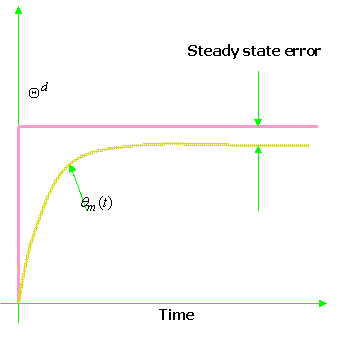
PD or PID control are suitable for slow point to point motion problem(regulation problem). In case of trajectory tracking problem the end-effector is moving along predefined path. In case of tracking problem desired position is a function of time. So it continuously changes with respect to time. Motor response will never catchup the desired position within shortest time by using PD or PID techniques only. So we cannot use PD or PID control strategy for trajectory tracking problem. |
| |
|
In this example we have to move end effecor from Ps to Pf along a straight line.
Figure 34.1 |
Figure 34.2 In trajectory tracking problem this is not constant but a function of time. is not constant but a function of time. |
|
| |
Contd... |