| |
Example 1.26
Let us consider a single counter at the railway booking counter at IIT Kanpur gate, where people arrive in order to buy/cancel railway tickets. Assume the time of arrivals are such that the server or the person at the counter can serve at time of 0, 1, 2,…., and for simplicity assume that in the time interval  the number of customers is random which is denoted by the number of customers is random which is denoted by  with with  ., which are i.i.d. random variables with probability mass function of ., which are i.i.d. random variables with probability mass function of  . Furthermore consider that due to space limitation only . Furthermore consider that due to space limitation only  number of persons can be accommodated in the small railway booking counter at the IIT Kanpur gate, where this includes the person at the counter who is booking/cancelling his/her ticket. In case if a passenger enters the booking counter and see that it is already full, then he/she leaves without booking/cancelling his/her ticket. Consider number of persons can be accommodated in the small railway booking counter at the IIT Kanpur gate, where this includes the person at the counter who is booking/cancelling his/her ticket. In case if a passenger enters the booking counter and see that it is already full, then he/she leaves without booking/cancelling his/her ticket. Consider  as the number of customer in the booking counter at time as the number of customer in the booking counter at time  ., then ., then  can be defined as a Markov chain which has the state space denoted by can be defined as a Markov chain which has the state space denoted by  . .
It is clear that we would have
and the probability transition matrix as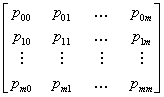
Now the probability distribution can easily be found out using the transition probability values,  , so that we can easily write , so that we can easily write
|