| |
Theorem 1.7
Let a finite Markov chain with state space  be also martingle. Then be also martingle. Then
(i)  for for 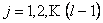
(ii)  for for 
(iii)  for for 
Proof of Theorem 1.7
Before we go through this simple proof we illustrate the concept of a martingle. Now a stochastic process  is said to be martingle process if (i) is said to be martingle process if (i)  for all for all  and (ii) and (ii) .Now taking expectation we have , .Now taking expectation we have ,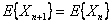 i.e., i.e., 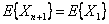 
(i) Let  be independent random variables with mean 0, and let be independent random variables with mean 0, and let  , then , then  is a martingle is a martingle
(ii) Let  be independent random variables with mean 1, and let be independent random variables with mean 1, and let  , then , then  is a martingle is a martingle
Now as this is a martingle as well as a Markov chain with transition probability matrix P, then we would definitely have 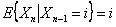 , , , then it means that , then it means that
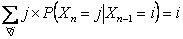 , i.e.,  |
Now  is satisfied for is satisfied for  iff iff  and for and for  iff iff  . Thus if a finite Markov chain is also martingle, then its terminal states are absorbing. . Thus if a finite Markov chain is also martingle, then its terminal states are absorbing.
Assuming that there are no further closed sets we get that the interior states, 1,2,…, (l-1) are all transient, hence  for for 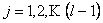 and similarly we have and similarly we have  for for  and and  for for  |