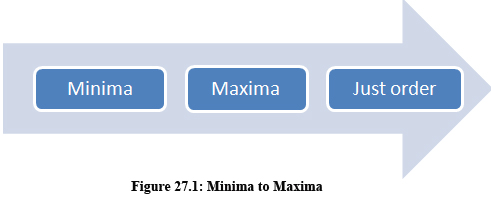
Minima to maxima
While various notions of development itself are floating in the air a more Gandhian vision of development seems to be gaining in consensus. This not only emphasizes fixing minimum standards but also maximum standards of development. If the maximum standards are not fixed, not only attainment of minimum standards will be impossible but it will further weaken the social fabric of transitional society.
To quote (Kothari, 1990b, 18):
The objective of development, should be to achieve minimum conditions of material welfare for all the people, the minima to be defined according to local conditions and norms, but all of them providing at the least a package of minimum items of human necessity such as food, clothing, shelter and nutritional needs to children and mothers in particular, and socially approved minima of health, education, drinking water and public transportation for all. The extent to which these minima should be translated into personal or family incomes or combined with social welfare programmes will depend on local conditions and the nature of the future political system. But it should not be difficult for any system to work out a policy on essential minima for all as a basic component of development planning.
A policy of minima entails a policy of maxima. Indeed, without the latter the former is, in practice, impossible to realise in reasonable time. …
|
In the next lecture we will specifically deal with the sources of change and the problem of postmodernization of values.
|