Exploitation is thus a diagnosis of the process through which the inequalities in incomes are generated by inequalities in rights and powers over productive resources: the inequalities occur, in part at least, through the ways in which exploiters, by virtue of their exclusionary rights and powers over resources, are able to appropriate surplus generated by the effort of the exploited. If the first two of these principles are present, but not the third, economic oppression may exist, but not exploitation. The crucial difference is that in nonexploitative economic oppression, the privileged social category does not itself need the excluded category. While their welfare does depend upon exclusion, there is no on-going interdependence of their activities. In the case of exploitation, the exploiters actively need the exploited: exploiters depend upon the effort of the exploited for their own welfare.
This conceptualization of exploitation underwrites an essentially polarized conception of class relations in which, in capitalist societies, the two fundamental classes are capitalists and workers. Capitalists, by virtue of their ownership and control of the means of production, are able to appropriate the laboring effort of workers embodied in the surplus produced through the use of those means of production. The Marxist tradition of class analysis, however, also contains a variety of strategies for elaborating more concrete class concepts which allow for much more complex maps of class structures in which managers, professionals and the self-employed, are structurally differentiated from capitalists and workers. Wright (1985, 1997), for example, argues that managers in capitalist firms constitute a type of “contradictory location within class relations” in the sense having the relational properties of both capitalists and workers.
The exploitation-centred concept of class provides a framework for linking the micro-level question about explaining individual material conditions and interests with the macro-level question about historical variation and the normative question about emancipatory transformation. What needs changing in capitalism is a system of property relations that confers power on capitalists and enables them to exploit and oppress others. This social organization of class relations is not an expression of a natural law, but is one form in a systematic pattern of historical variation. And the life experiences and interests of individuals living within these relations generate patterns of conflict that have the potential of pushing these historical variations in ways that accomplishes the emancipatory transformation.
The Two Traditions Compared
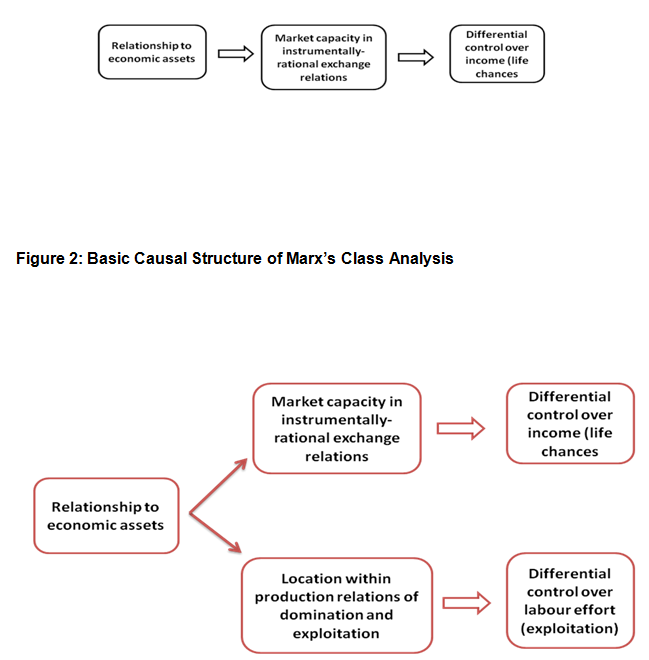
The contrast between Marxist and Weberian frameworks of class analysis is illustrated in figures 1 and 2.
Figure 1: Basic Causal Structure of Weber’s Class Analysis