Improving Stability Margin
This is a consequence of the improvement in the power angle characteristics and is one of the major benefits of using midpoint shunt compensation. As mentioned before, the stability margin of the system pertains to the regions of acceleration and deceleration in the power-angle curve. We shall use this concept to delineate the advantage of mid point shunt compensation.
Consider the power angle curves shown in Fig. 10.6.
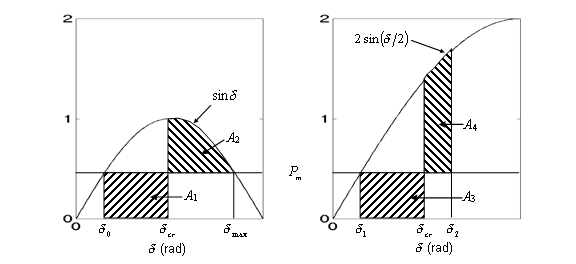
The curve of Fig. 10.6 (a) is for an uncompensated system, while that of Fig. 10.6 (b) for the compensated system. Both these curves are drawn assuming that the base power is V2/X . Let us assume that the uncompensated system is operating on steady state delivering an electrical power equal to Pm with a load angle of δ0 when a three-phase fault occurs that forces the real power to zero. To obtain the critical clearing angle for the uncompensated system is δcr , we equate the accelerating area A1 with the decelerating area A2 , where
with δmax = π - δ0 . Equating the areas we obtain the value of δcr as
 |
(10.11) |
Let us now consider that the midpoint shunt compensated system is working with the same mechanical power input Pm. The operating angle in this case is δ1 and the maximum power that can be transferred in this case is 2 per unit. Let the fault be cleared at the same clearing angle δcr as before. Then equating areas A3 and A4 in Fig. 10.6 (b) we get δ2, where
Example 10.1
|