Electric Conduction in Insulating Liquids
|
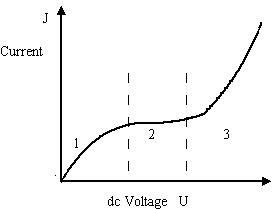
The conduction mechanism in a dielectric liquid is strongly affected by the degree of its purity. In liquids, which have not been highly purified, when subjected to fields upto about a few kV/cm the conduction is primarily ionic. Ionic conduction is affected by the dissociation process of impurities as well as the injection of charge by the electrodes through electrochemical reactions. The electrons do not take part in the passage of current through such liquids. A typical characteristic of conduction current density J versus the applied dc voltage U in a pure liquid is shown in Fig.14.1. At low voltages, the current varies proportionally to the voltage, region 1, representing the ohmic behavior. On raising the applied voltage, hence the field intensity, the ionic current gets saturated, region 2. At still higher applied voltage the current density increases rapidly until the breakdown occurs, region 3.
|
|
Fig. 14.1 Typical voltage-current (U-J) characteristic in dielectric liquids.
|
Similar behavior is observed generally in, both, polar and nonpolar liquids. In some cases the saturation region may be completely missing. This characteristic has an analogy to what has also been observed commonly in gases. |
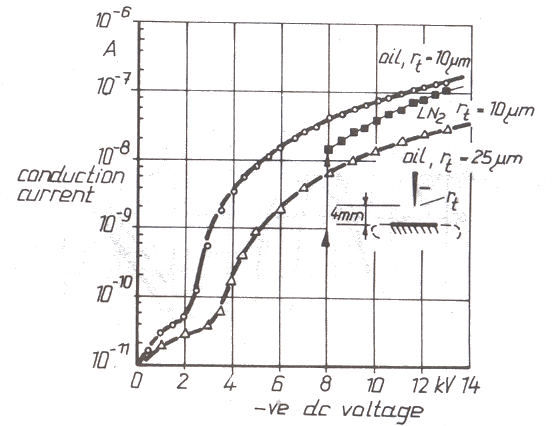
In Fig. 14.2 the conduction current characteristics are shown for negative direct voltage applied to a needle-plane electrode configuration in transformer oil and liquid nitrogen, measured by Takashima et al. [3.1] for different radii of curvature 'rt' of the needle tip. For these experiments, the needle constituted of a polished platinum wire of radius 0.25 mm and the plane of 50 mm diameter Rogowsky profile curved plate of stainless steel. The current was measured through the plane electrode for a constant gap distance of 4 mm. The sharp bend measured on the curve is supposed to represent the development of a strong space charge around the needle. |
|
Fig 14.2 Conduction current in oil and liquid nitrogen for negative needle-plane electrode gap of 4mm with increasing voltage. Oil at 20 oC and LN 2 at 77.3 K Takashima et al. [ 3.1]. |
The concentration of charge carriers and the viscosity of insulating liquids are both strongly affected by the temperature which in turn influences the conductivity of the liquid. According to Van't Hoffsch law, the conductivity 'κ' within a certain range of temperature follows the relation: |
|
where k is Boltzmann constant, T absolute temperature, κ0 and F are material constants. F is known as 'activation energy' and is expressed as kcal/mole. |
| However, Van't Hoffsch law is valid only in the region where the conduction current follows the ohmic behavior, that is region 1 in Fig. 14.1. It thus depends upon the particular liquid and its impurity contents (for example, humidity content etc.). |
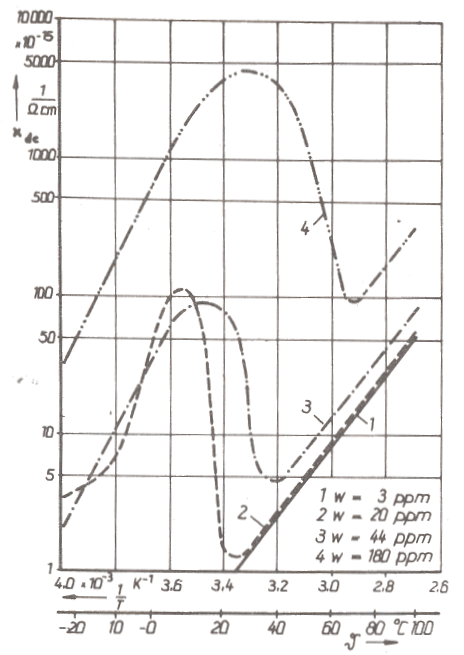
Transformer oil conductivity variation for a wide range of temperature for different moisture contents measured by Holle [3.2] are illustrated in Fig. 14.3. It is evident from this figure that the conductivity of oil increases as the water ppm content rises.
|
|
Fig 14.3 Direct current conductivity of transformer oil for different water contents w (ppm) with respect to the reciprocal of absolute temperature, Holle [ 3.2]. |
In case of highly purified liquids which are able to withstand high field intensity, the conduction phenomenon is different. By increasing the field intensity to the order of a few hundred kV/cm, the conduction current in both polar and nonpolar liquids is augmented predominantly by charge carriers injected into the liquid from the electrode surfaces. Besides, the field aided dissociation process of molecules is intensified. Under certain given conditions, the presence of an injected space charge, say of density q, gives rise to a Coulomb's force of density qE. Due to the action of this force, hydrodynamic instability is caused, developing convection motion in the liquid. Investigations made by many authors, on both polar and nonpolar liquids, have concluded that whenever conduction in an insulating fluid is accompanied with a significant charge injection, the convection motions occur, which are also known as 'electrohydrodynamic' (EHD) motions. The EHD motions augment the passage of current depending upon the charge injection intensity, which in turn is determined by the applied voltage, the nature of liquid and the electrode material, Zahn [3.3], Takashima [3.1] and Atten [3.4]. |
Atten [3.4] explained the effect of the phenomenon of EHD motion on the conduction in liquid dielectrics under two extreme conditions: with and without unipolar injection of charge. For his experimentation, an extremely nonuniform field configuration between a knife and a plane was taken, as shown in Fig. 14.4.
|
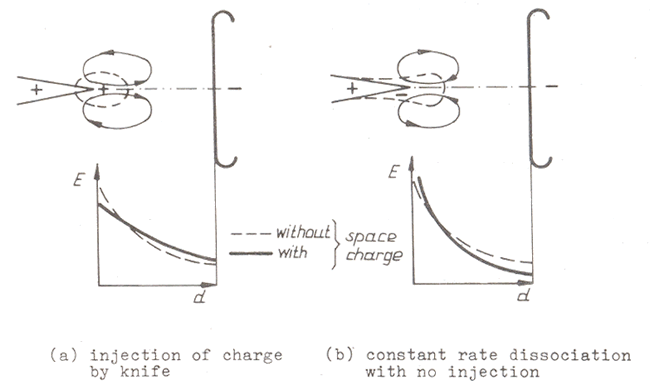 |
Fig 14.4 Schematic representation of space charge zone and liquid motion streams between knife-plane electrodes and the field distribution along the axis, Atten [ 3.4]. |
Consider first the case of injection of unipolar charge (ions) by the knife (Fig. 14.4 a). The field at the tip of the knife electrode is reduced because of the same polarity space charge being injected, whereas an increase in the field intensity is caused over the basic field towards the plane electrode. The space charge zone is of finite extent when a moderate voltage is applied. Under this condition, the liquid relaxation time is lower than the transit time of the ions from the knife to the plane. The total current is, therefore, higher than the ohmic current because of the enhancement of field intensity near the plane. Moreover, due to the action of the electric field on the same polarity charge close to the knife, a 'stream' or 'jet' of liquid towards the plane is induced in this region. |
In case of pure conduction with no injection of charge, Fig. 14.4(b), an opposite polarity space charge near the knife extends further. Consequently, the space charge field at the tip increases, and is reduced with respect to the basic field towards the plane. This results in lower total current than the ohmic current (sub-ohmic behavior). The opposite polarity space charge in the vicinity of the knife gives rise to a liquid motion directed towards the knife. |
| At extremely high field intensities (1000 kV/cm and above) approaching the 'intrinsic strength' of liquid dielectrics, the field emission at the electrode surfaces affects the conduction phenomenon. Under these conditions, the conduction current is dominated by electrons. |
| |