| Breakdown by Streamer Discharge (Streamer or Kanal Mechanism) |
| According to Townsend's generation mechanism, the time required for breakdown by normal avalanche propagation is determined by the drift velocity of electrons in a few generations. The estimated time required for breakdown in comparatively longer gap distances by this theory was too long, contrary to the actual time measured experimentally. With the development of electrical and optical measurement methods, this was confirmed by Raether as early as 1939 [2.6]. This necessitated a novel approach for breakdown mechanism suitable for longer gap distances than as explained by Townsend in uniform fields. |
- The streamer breakdown mechanism describes the development of spark breakdown directly from a single avalanche.
- The space charge developed by the avalanche itself due to rapid growth of charge carriers, transforms it into a conducting channel. As described by Raether, it is the 'eigen space charge' which produces the instability of the avalanche.
|
- The word streamer literally means a ribbon attached at one end and floating or waving at the other, which appears to be a set of waves or ripples moving forward. Streamer also means a column of light shooting up in aurora.
- This kind of visual display results during a discharge due to the movement of pockets of ionized particles.
- The term 'Kanal' is taken from German language which means a canal or a channel.
|
- The approximate calculations of the conditions required for the space charge field of avalanche Ea to be able to acquire the magnitude of the order of the externally applied field E0, confirmed that the transformation from avalanche to streamer began to develop from the head of an electron avalanche, when the number of charge carriers increased to a critical value,
|
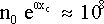 |
- For an avalanche initiated by a single electron (n0 = 1) in a uniform field, this corresponds to a value,
|
 |
where xc is the length of avalanche in the field direction when it amplifies to its critical size.
|
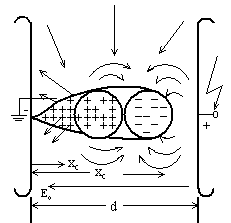
In other words, xc is the critical length of the electrode gap dc. This means that the streamer mechanism is possible only when d ≥ xc. If xc is longer than the gap length d (xc > d) then the initiation of streamer is unlikely as shown in Fig.9.1
|
- On the basis of experimental results and some simple assumptions, Raether developed the following empirical formula for the 'streamer breakdown criterion'.
|
|
- The interaction between the space charges and the polarities of the electrodes results in distortion of the uniform field.
|
- Field intensities towards the head and the tail of avalanche acquire a magnitude (Ea + Eo ), while above the positive ion region, just behind the head, the field is reduced to a value (E0 - Ea), (see Fig. 9.1).
|
|
Fig 9.1 Effect of space charge field Ea of an avalanche of critical amplification on the applied uniform field. |
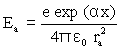
- If the charge lies nearly in a spherical shape of radius ra then the field at the surface of this space charge in the form of a sphere is,
|
|
where e is the elementary charge of an electron and ε0 the absolute permittivity constant.
|
- The condition for transition from avalanche to streamer breakdown assumes that this eigen space charge field approaches near the externally applied field (Ea ≈ E0). Hence the above breakdown criterion becomes,
|
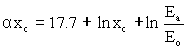
| α xc= 17.7 + ln xc |
- The minimum value of αxc required for breakdown in a uniform field gap by streamer mechanism is obtained on the assumption that the transition from avalanche to streamer occurs when an avalanche of critical size just extends across the gap d. By incorporating this condition, the breakdown criterion takes the form,
|
αdc = 17.7 + ln xc
≈ 20 |
- Thus the condition xc = dc gives the smallest value of α to produce streamer breakdown, where dc is given in cm. For α xc = ln 108 , xc works out to be equal to 2cm which can be considered to be critical gap distance, dc, for streamer phenomenon to take place in atmospheric air in uniform field.
- The 'streamer breakdown criterion' can be therefore interpreted as a condition for the development of significant field distortion caused by stark space charge within a single avalanche so that its field intensity is comparable to the externally applied field.
|
|
|
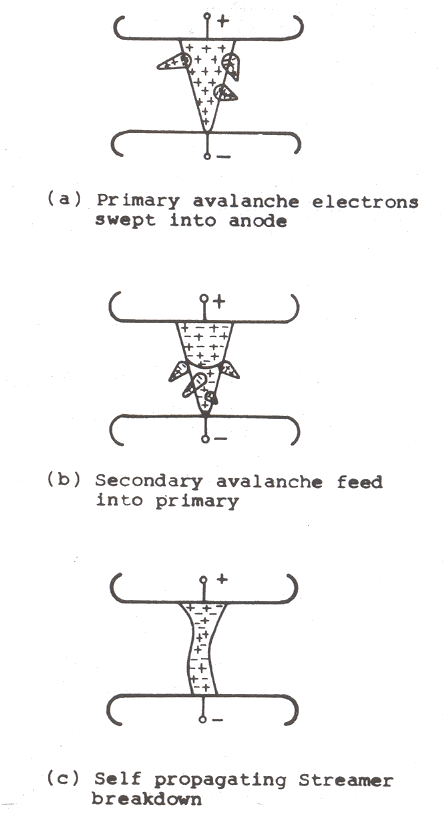
Fig 9.2 Schematic of a cathode directed streamer breakdown showing development stages. |
- In sufficiently long air gap in uniform field when the avalanche extends across the gap, the electrons are swept into the anode, and the positive ions in the tail of the avalanche stretch out across the gap as shown in Fig. 9.2.
- A highly localized space charge field due to positive ions is produced near the anode but since the ion density elsewhere is low, it does not constitute a breakdown in the gap.
- In the gas surrounding the avalanche, secondary electrons are procuded by photons and photo-electric effect from the cathode.
- The secondary electrons initiate the secondary avalanches, which are directed towards the stem of the main avalanche, if the space charge field developed by the main avalanche is of the order of the applied field. Thus the secondary avalanches feed into the primary avalanche as shown in Fig. 9.2 (a), (b).
- The positive ions left behind by the secondary avalanches effectively lengthen and intensify the space charge of the main avalanche in the direction of the cathode and the process develops a self propagating streamer breakdown shown in Fig. 9.2 (c).
|
- Significant development in high-speed photographic techniques, strengthened by the incorporation of image converters and image intensifiers have made it possible to record the progress of the discharge light output at earlier stages than hitherto.
|
- Figure 9.3 shows the photograph of an avalanche where secondary avalanches are feeding into the primary avalanche, taken in a gap of 3.6 cm in air at 270 Torr and a field intensity of about 12,200 V/cm by Raether [2.6.]
|
|
Fig. 9.3 Photograph of a cathode directed streamer developed from an avalanche, Raether [ 2.7] |