|
Breakdown by Avalanche Discharge (Townsend Mechanism) |
- When the distance d between two electrodes in a uniform field is very small, α the Townsend's first ionization coefficient which is a function of field intensity E, may still have quite a low value even at the breakdown field intensity.
- Under these conditions, the avalanche space charge concentration is not able to acquire its critical amplification (the total number of electrons ≈ 108).
- Production of sufficient number of charge carriers in the gap under such conditions is possible only by secondary ionization process, also known as
 - process.
- These secondary processes are ionization of the gas 'by positIve ions and photons from the excited molecules, and ejection of electrons from the cathode by following effects:
|
-
Positive ion effect ' ion': While the positive ions, produced in the primary avalanche, cannot gain enough kinetic energy in the electric field to ionize molecules, they may have sufficient potential energy to cause ejection of electrons upon striking the cathode.
-
Photon effect ' p': Excited molecules in the avalanche may emit photons on returning to their ground state. This radiation falling on cathode may produce photo-emission of electrons.
- Metastable effect ' m': Metastable molecules may diffuse back to the cathode and cause electron emission on striking it.
|
- The three processes of cathode effect are described quantitatively by a coefficient '' as follows,
|
 |
- ' ' is known as Townsend's secondary ionization coefficient. It is defined as the number of secondary electrons on an average produced at the cathode per electron generated by the primary process, that is, per ionizing collision in the gap. ' ' strongly depends upon the cathode material and is a function of field intensity and pressure of the gas."
|
 |
- Like α, also represents a probability process. If the mean number of secondary electrons per avalanche produced are μ, then considering Equation 7.4,
|
 (8.1) |
If the primary electron generation process begins with n0 number of electrons, the second generation begins with μn0number of electrons.
- Average current growth with respect to the applied voltage and time are shown in Figs. 8.1 - 8.3
|
|
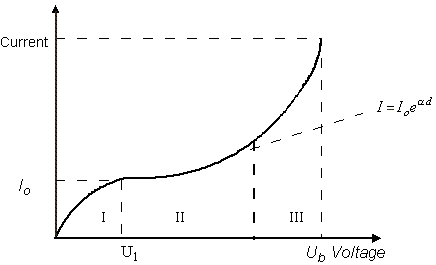
Fig 8.1 General conduction current-voltage characteristics before breakdown. |
- In order to measure the U-I characteristic, Townsend's original experimental arrangement had uniform field electrodes enclosed in a glass vessel. This vessel was provided with a quartz window for irradiating the cathode with ultra violet light to emit photo electrons [2.9].
- As the voltage applied is raised, the initial current through the gap increases slowly to a value Io
- The magnitude of this current depends upon the ultra violet illumination level of the cathode, region I, shown in Fig. 8.1.
- The electrons emitted from the cathode move through the gas with an average velocity determined by their mobility at the field intensity in the gap.
- The initial increase in current is followed by an approach to saturation because some of the electrons emitted from the cathode return to it by diffusion.
- The proportion of electrons which diffuse back decreases as the voltage is increased, but not all the electrons emitted reach the anode, even at the voltages at which ionization in the gas begins to occur.
- Thus, in general, there is no well defined plateau in the U-I characteristic, and the current eventually increases rapidly through the regions II and III with increasing voltage until a breakdown occurs at some well defined voltage U = Ub[2.10].
- Whatever may be the level of initial illumination of cathode, the voltage Ubat which the breakdown occurs remains unaltered.
- The increase in current in region II is derived from the process of field intensified ionization by primary or α - process.
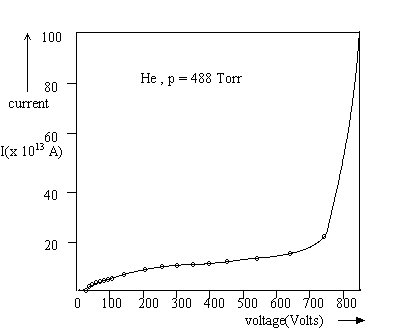
- The secondary or γ -process accounts for the sharper increase in current in region III and for an eventual spark breakdown of the gap. Figure. 8.2 shows the U-I characteristic in helium at a pressure of 488 Torr, measured by Rees [2.11]. It is evident from the Fig. 8.1 and 8.2 that the characteristics measured by Townsend and Rees are very similar.
|
|
Fig 8.2 Voltage-current (U-I) characteristics in helium measured by Rees [ 2.11] in 1963. |
- It is a distinguishing feature of breakdown that the voltage across the gap drops in the process which produces a high conductivity between the electrodes. This takes place in a very short time (in μsecs).
- If α is the primary ionization coefficient for the applied uniform field E0 ,the amplification of ionizing collisions of the electrons is given by eαx .
- In the event of positive ion space charge distorting the field, the amplification of α which increases with distance and time is given as,
|
 |
For this case, μ(t) can be written as,
|
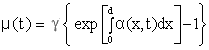 |
which grows continuously above 1, till breakdown occurs.
- Experiments have been performed to study the current growth in uniform fields in air and other gases initiated by a single electron (n0 =1) with the help of a light flash. The process with higher number of electrons (n0 » 1) is achieved by illuminating the cathode with constant intense light [2.12-2.14].
- Hoger [2.13] developed one such method of measurement in nitrogen.
- With the help of theoretical considerations confirmed with experimental results, he computed the current growth started by a single and more number of electrons as in Fig. 8.3. The measured values are indicated by the vertical lines.
- At lower values of current, the statistical distribution scatters more compared to the distribution at higher current values.
|
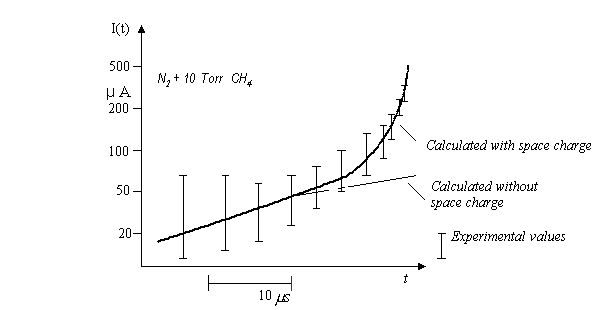 |
Fig 8.3 Current growth initiated by a single electron, (E/p 20 = 44.8 V/cm. Torr, d = 2 cm, α d = 12.3, µ = 1) on semilogarithmic plot by Hoger [ 2.13] 1963. |
- The movement of charge carriers (electrons and positive ions) in the gap is responsible for the growth of circuit current.
- The saturation level of the curve in Fig 8.1 (region II) is also called the steady state region.
- If it is assumed that the number of positive ions diffusing per second at the cathode are just equal to the number of newly formed electrons arriving at the anode, the growth of current in this region can be given by,
|
 (8.2) |
where I0 is the initial photo-electric current at the cathode.
- Although this expression represents the averaged effect of a number of avalanches, it fails to signify the breakdown.
- The current in region III has a much steeper rise till a breakdown occurs which is rendered to the γ, or secondary ionization process.
- The Townsend's current growth equation in this region is derived in [2.9] as follows:
|
Let
|
n0 = the number of primary electrons (photo electrons) emitted from the cathode (at x = 0) per second. In other words, an avalanche in uniform field develops at the cathode with n0initial electrons.
n0' = the number of secondary electrons produced at the cathode per second. and
n0" =
the total number of electrons leaving the cathode per second.
|
Thus n0" = n0 + n0' (8.3)
|
- Since each electron leaving the cathode makes on an average (eαd - 1) collisions in the gap d, therefore, the total number of ionizing collisions per second in the gap will be n0" (eαd - 1) .
- By definition, γ is the number of secondary electrons produced on an average at the cathode per ionizing collision in the gap, then,
|
| n0' = γ n0" (eαd - 1) (8.4) |
Substituting Equation 5.9 in 5.8, we have
|
| n0" = n0 + γ n0" (eαd - 1) |
or 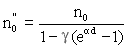 (8.5) |
- From Equation 7.4, the number of electrons arriving at the anode is given by,
|
| nd = n0" eαd |
By putting the value of n0" in the above equation, we have
|
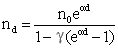 (8.6) |
- Under the steady state conditions, the current in the gap can therefore be given by,
|
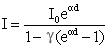 (8.7) |
This equation describes the growth of average current in the gap before the breakdown.
- According to Equation 8.1, (eα d - 1) in the denominator of Equation 8.7 represents μ, the mean number of secondary electrons produced per avalanche. For μ << 1, the secondary ionization, or γ - process is insignificant. Then equation 8.7 reduces to I ≈ I0 eα d, which represents the region II in Fig. 8.1. The applied voltage and hence the field intensity is low in this region. This condition is also described as 'non-self-sustaining discharge', or ionization process, under which a breakdown would not be able to develop by itself.
|
- As the applied voltage, and thus the field intensity E is increased, the value of μ approaches 1. Then the denominator of this equation approaches zero and, therefore, the current I tends to rise unlimitedly. At this stage, the current is however limited by the impedance offered by the power supply and by the gas itself. Under these conditions, the discharge or ionization process becomes self-sustained to maintain the level of required charge carriers, described as a 'self-sustaining discharge'.
- The quantitative condition for breakdown can be expressed as,
|
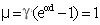 (8.8) |
This equation is known as the 'Townsend Criterion' for spark breakdown in uniform field.
- At the final stage of breakdown, the electron amplification is normally much greater than one (eαd >> 1), so the criterion reduces to
|
 (8.9) |
- Under the condition when μ > 1, a strong concentration of charge carriers grow in the subsequent 'generations' of electron production.
- These equations and conclusions are also valid for weakly nonuniform fields where the μ is defined in slightly different way as follows:
|
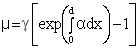 (8.10) |
- The Townsend's mechanism of spark breakdown can, therefore, be explained on the basis of the observation that the ionization process begins with a number of 'series of avalanches'.
- It extends over the whole gap and ultimately constricts into a spark or breakdown channel. A conceptual schematic of the breakdown mechanism is shown in Fig. 8.4.
|
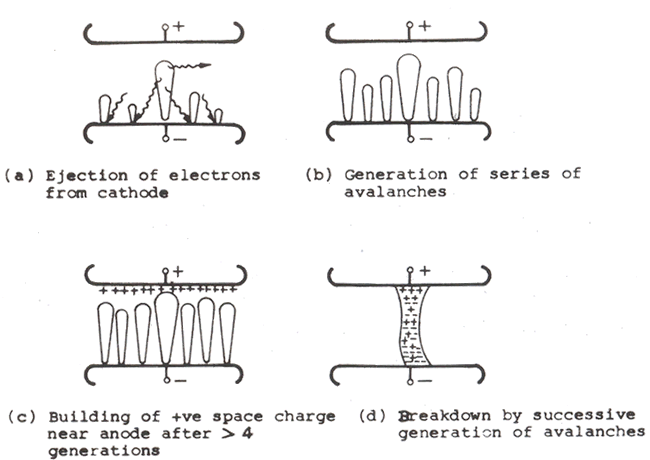 |
Fig 8.4 Townsend breakdown mechanism schematic. |
| |