Module 2 : Gaseous Dielectrics
Lecture 5 : Properties of atmospheric air and SF6 , Related ionization Process
Properties of Sulphurhexafluoride, SF6  Gas

Sulphurhexafluoride was first produced in 1900 by French scientists Moissan and Lebeau by direct fluoronisation of sulphur. In the beginning it was mainly used as a dielectric in atomic physics. During late 1950s, it found application in high voltage circuit breakers. Ever since, its application in power systems has been continuously increasing.

Physical Properties
  • In a SF6 molecule, six fluorine atoms arrange themselves uniformly like an octahedron on a central sulphur atom. An excited sulphur atom can therefore form six stable covalence bonds with the strongly electronegative fluorine atoms by sharing the pair of electrons.
  • Amongst halogens, the fluorine element and the sulphur atom both have very high coefficients of electronegativity, of the order of 4 and 2.5, respectively. This coefficient is a measure of the tendency to attract electrons of other atoms to form dipole bondage.
  • The rigid symmetrical structure, small binding distance and high binding energy between atoms of a SF6 molecule provide it high stability.
  • Thermal dissociation in highly purified SF6 gas begins at extremely high temperatures (above 1000 K). Such high temperatures in power systems occur only in electrical arcs. Even at continuous temperatures upto about 500 K, neither thermal decomposition of SF6 nor its chemical reaction with other materials have been reported.
  • Further, SF6 is a nontoxic, colourless and odourless gas.
  • Some important physical properties of SF6, other than molecular properties, are brought together in Table 5.2.
Table 5.2  Physical properties of SF6 [2.1]
Property
Physical
conditions
Symbol
Unit
Value

Relative Permittivity

0.1 MPa, 25°C
- 51°C (liquid)
εr
--
1.002
1.81 ± 0.02

Dielectric loss tangent

0.1 MPa,
- 51°C (liquid)
tan δ
--
< 5.10-6
< 5.10-6

Critical temperature

--
θcr
0C
45.5

Tripple point

p=0.22 MPa
θT
0C
-50.8

Sublimation point

.
θs
0C
-63.8

Specific heat capacity

at 100 C and constant
p=0.1 MPa
Cp

5.13
.
at 100 C and
const. volume
Cv
4.06
Heat conductivity
300 C
--
0.82.10-5

Heat transition No.

--
--
0.44.10-5
 
  • The molecular mass of SF6 is quite high (146), it has a high density. Because of high density the charge carriers have short mean free path. This property, along with the properties of electron attachment, that is, electronegativity and high ionization energy result in high dielectric strength of SF6.

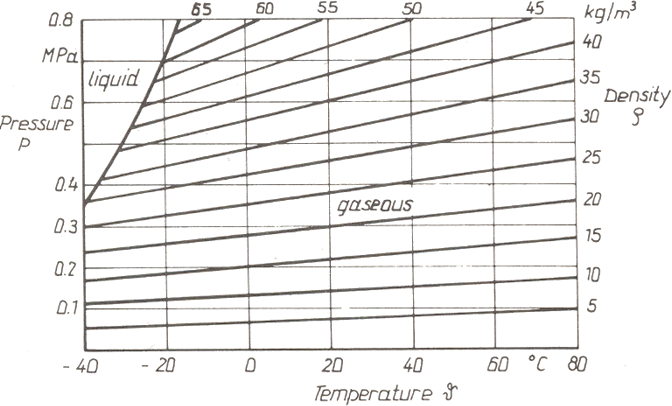
In Fig. 5.1 the two states of SF6, liquid or gaseous, are shown at varying pressures and temperatures for different constant densities of the gas. This diagram is important from the point of view of practical application of SF6 in GIS. Within the range of working pressure and temperature of the gas, it should not liquefy as its electrical insulation properties are affected.

Fig 5.1 States of SF6 for different constant gas densities and varying temperature and pressure within practical application range