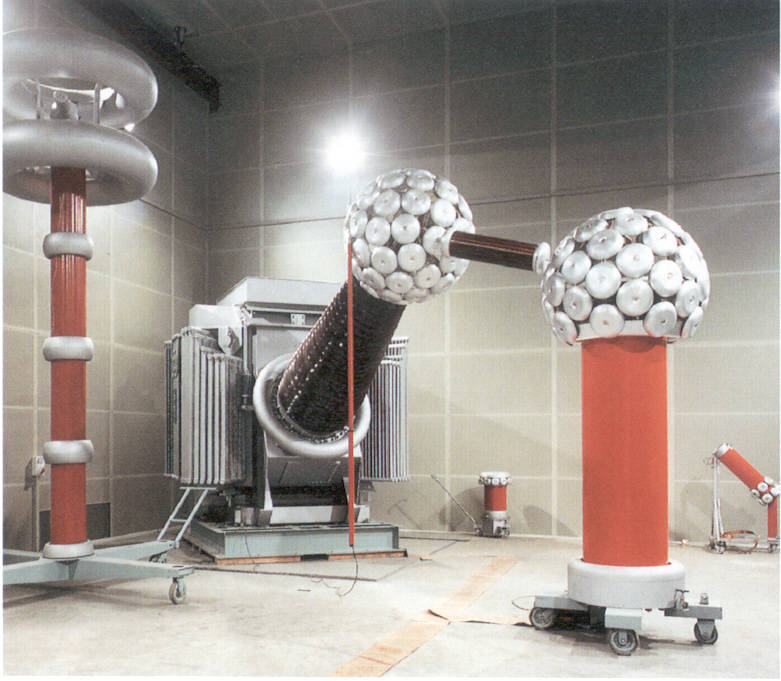
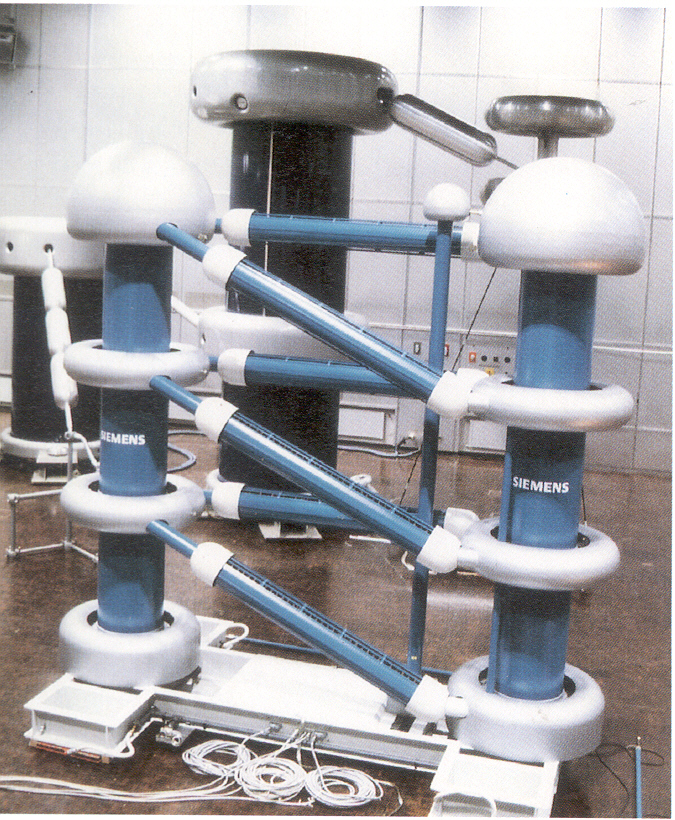
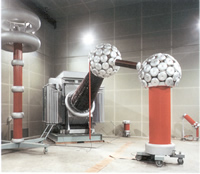
- Electrodes at high potentials in the laboratory are given large, smooth shaped dome like bodies or shapes like toroids to bring down electric stress on the atmospheric air (dielectric). The modern trend in such electrode design includes 'segmented electrodes', constituting a number of small, identical, smooth discs given a large desired continuous shape as per requirement. The curvatures of the individual segment discs are worked out by optimisation of the suggested profiles. Fig 4.2 shows both, single metallic body and segmented electrodes used in HV test apparatus for stress control.
|
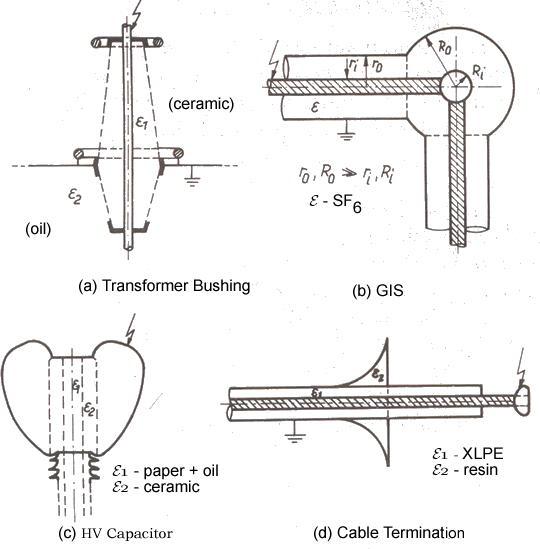
- Extended shapes of electrodes, also known as 'shields', are suitably provided on high voltage apparatus for electric stress control as shown in Fig 4.3. Sharp contacts are often enveloped by a large diameter hemispherical electrode having an aperture, or provided with concentric toroidal rings (doughnut shaped ring). Spheres with smooth holes are provided at bends for the connections of circular and tubular electrodes. Instead of wires, tubular electrodes of large diameters are used for connections in high voltage laboratories which bring down the field intensity at higher voltages considerably. These measures are necessary not only to prevent any partial breakdown(corona) occurring in the laboratory but also to check radio interference.
|
- It is a common practice to use bundles of two or more number of conductors at the same potential instead of a single conductor, to bring down the electric stress, i.e., for stress control, (Fig. 2.1 b). As the transmission voltages are increasing, bundles with eight or even more number of conductors are being used at higher voltages.
|
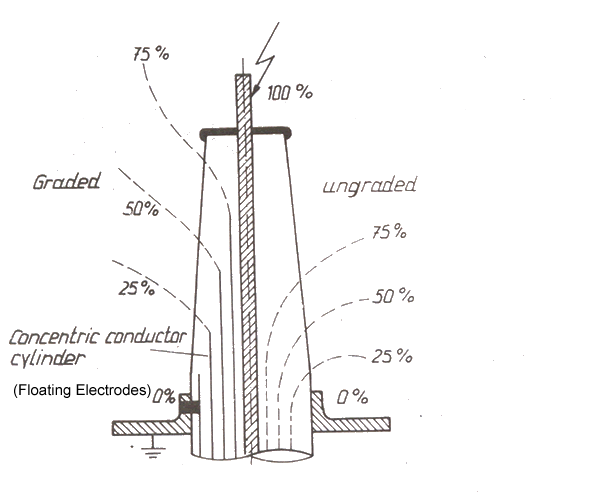
- Capacitive grading is provided in high voltage bushings, potential transformers and cable terminations in order to achieve a better potential distribution leading to a more uniform field distribution in the dielectric. It is achieved by inserting concentric conductive layers at appropriate positions, known as 'floating screens', to control the electric stress as shown in Fig. 4.4. This enables an economic utilisation of the insulating material by evenly distributing the equipotential surfaces in the complete dielectric.
|
- Use of screen (also known as concentric conductor at ground potential) over the insulation in coaxial high voltage cables is made to control the electric stress. The field achieved in these screened cables is radial and generally a weakly nonuniform field. For making cable joints and terminations, the,screen is extended in the form of a cone, known as 'stress cone'. This helps in achieving a more uniform distribution of electric stress in the dielectric at cable end termination as shown in Fig. 4.3 (d).
|
- A modest thumb rule to control electric stress in high voltage apparatus is to avoid sharp points and edges. Symmetrical, smooth shaped and large electrodes are preferable. It must be borne in mind that even the roughness on metallic surfaces can lead to distortions in the field at higher voltages. Furthermore, microprotrusions may grow and penetrate deeper in the dielectric leading to excessive field enhancement. These must be prevented from developing, firstly during manufacturing stage and subsequently during service and maintenance.
|
|
|
|
Segmented electrodes(Complete HV lab (600 kV AC)) |
|
Single metallic body (DC Generator 900 kV) |
Fig 4.2 (Click on images to have an enlarged view) |
|
|
| Fig 4.3 Extended shapes of electrodes for stress control (a) A bushing with toroids (b) Right angle bend of a bus bar in gas insulated switchgear (GIS), (c) HV electrode on a condenser, (d) stress cone at a screened cable end. |
|
Fig 4.4 Potential distribution in a bushing with and without capacitive grading [ 1.1, 1.2] |