Module 7 : Non-destructive High Voltage Testing and Quality Control
Lecture 34 : Measurable properties of dielectrics
When an alternating voltage is applied to dielectrics, they undergo active as well as reactive power losses in the capacitance formed by the dielectric. The dielectric losses vary not only with the magnitude of the applied voltage but also with the frequency of the voltage and the temperature of the dielectric. The magnitude of the losses are best assessed with the knowledge of "Dielectric Loss Tangent, tanδ" . Like the relative permittivity or the permittivity number, εr, , tanδ is also a function of
tanδ = f (v, f , v)
Dielectric loss tangent
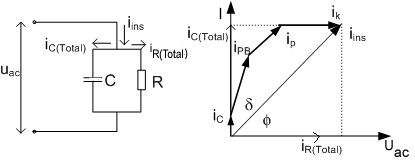
' tan' is defined as the quotient of active to reactive power loss in a dielectric when an alternating voltage is applied.
Figure 34.3 Conductive mechanisms in insulating materials with alternating voltages
where
= capacitive charging current
= partial discharge impulse currents
= polarization currents
= conductive currents
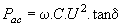
The active part of total insulation current through the capacitor is . Hence the active power loss is given by.
Where C is total effective capacitance of the test object: tan is a function of temperature, frequency and magnitude of the applied voltage U.

 ' is defined as the quotient of active to reactive power loss in a dielectric when an alternating voltage is applied.



 . Hence the active power loss
 is given by.