Lecture 32 :
Electrostatic Voltmeters, Principle and Construction
Electrostatic Voltmeters
Electrostatic Voltmeters produced upto 1000 kV rated voltage are suitable for the measurement of ac power frequency and also for higher frequency rms voltages. They can also measure dc voltages.
For higher voltage range compact voltmeters with SF6 gas or vaccum insulation gap are also produced.
These voltmeters were suggested by Kelvin in 1884 for the measurement of rms value of power frequency voltage. They are developed to follow the Coulomb's law which defines the static electric field as a field of force.
The field produced between two parallel plate electrodes with shaped profile brims, is a uniform field.
If the voltage applied across these parallel plates having a gap distance 'd' is U, then the uniform field produced in the gap between them will have an intensity E equal to U/d.
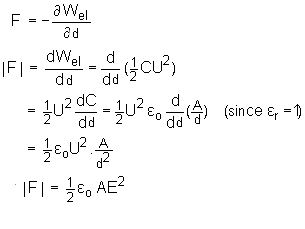
The attracting force F between the plates on area A of the electrodes is equal to the rate of change of stored electrical energy Wel per unit distance in the capacitance formed between the plates.
Therefore
or
(32.1)
or
Where = permittivity of the insulating medium
d = gap distance between the parallel plate electrodes of area A.
Fig 32.1 Schematic of an Electrostatic Voltmeter
The attracting force is always positive independent of the polarity of the voltage. If the voltage is not constant, the force is also time (frequency) dependent. Then the mean value of the force is used to measure the rms value of the voltage. Thus
(32.2)
where T is a proper integration time.
Electrostatic voltmeters are arranged such that one of the electrodes or a part of it is allowed to move.
Thus electrostatic voltmeters are rms indicating instruments if the force integration and its display follows eqn-32.2.
Various voltmeters developed differ in their use of different methods of restoring forces required to balance the electrostatic attraction. This can be achieved by suspension of the moving electrode on one arm of a balance or its suspension on a spring or the use of a pendulous or torsional suspension.
The small movement is generally transmitted and amplified by a spot light and mirror system, but many other systems have also been used.
The electrostatic measuring device can be used for absolute voltage measurements since the calibration can be made in terms of the fundamental quantities of the gap length and forces.
For a constant electrode separation 'd' the integrated forces increase with (Urms)2 and thus the sensitivity of the system for low ranges of the rated voltages of the instrument is small. This disadvantage is overcome, however by varying the gap length in appropriate steps.
The high pressure gas or even high vacuum between the electrodes provide very high resistivity, therefore the low active power loss.
The measurement of voltages lower than about 50V is , however not possible as the forces become too small.
The load inductance and the electrode system capacitance, however, form a series resonant circuit which must be damped, thus limiting the frequency range.
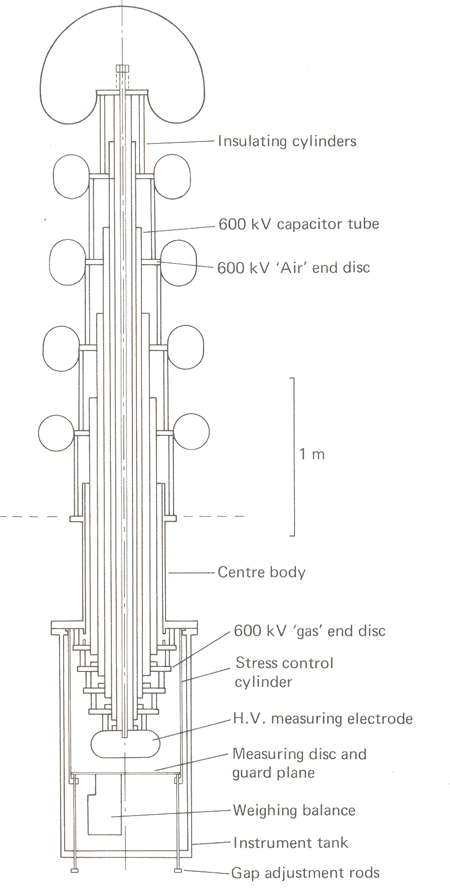
Sectional view of a 1000 kV standard electrostatic voltmeter using SF6 gas is shown below in Fig. 32.2
Fig 32.2 Sectional view of 1000-kV electrostatic voltmeter
A five section capacitor and oil insulated bushing is used to bring the extremely high voltage into the instrument metal tank, filled with pressurized SF6
The HV electrode and earthed plane provide uniform electric fields in the region of the 5 cm diameter disc set in a 65 cm diameter guard plane.
The measurement accuracy of this instrument is of the order of 0.1%.

 (32.1)
  = permittivity of the insulating medium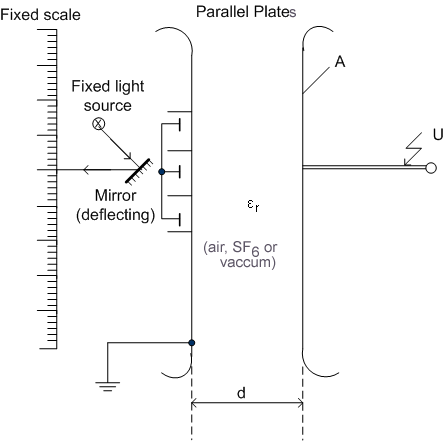
 (32.2)