Module 4 : Breakdown in Solid Dielectrics
Lecture 22 : Thermal and other Breakdown Mechanisms in extremely non-uniform fields

'Treeing' a Prebreakdown Phenomenon in Polymeric Dielectrics

Treeing is an electrical pre-breakdown phenomenon. The name is given to the type of damage caused to the solid dielectrics, which progresses through its certain part under electric stress in extremely non-uniform fields. The path of its growth appears like a miniaturized tree, hence the name given to this phenomenon. Treeing process normally begins at a very sharp, pointed electrode tip due to internal partial breakdown which take placeuner extremely nonuniform field conditions. Extreme field distortions at protrusions in the dielectrics may also give rise to the development of treeing process.

Treeing may occur and develop slowly due to PB. In the presence of moisture it may develop slowly even without any measurable PB. However, treeing develops rapidly when very high impulse voltage is applied. While treeing is generally associated with ac and impulse voltages, it also takes place under high dc stresses. Evidences are there that the treeing process is aggravated by the presence of moisture, chemical environment, voids and contaminants such as foreign particles. Treeing may or may not be followed by complete electrical breakdown of the part of the dielectric where it occurs. However, in solid polymeric dielectrics it is one of the most common cause of electrical failure. The whole process may or may not take long time for it strongly depends upon the local conditions.


Forms of Treeing Patterns

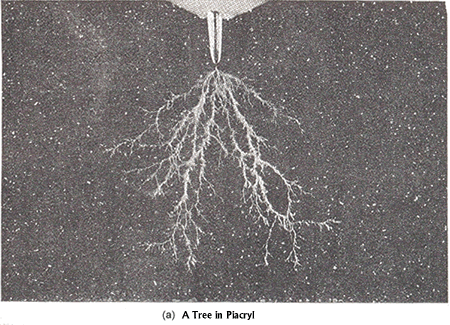
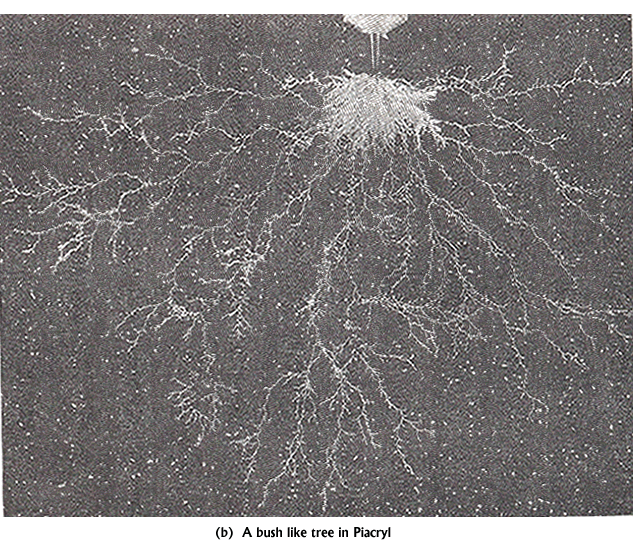
The great variety of patterns which appear like stems and branches comprising an electrical tree, are described in the literature with large number of corresponding names of the figures such as, dendrite, fan, plume, delta, bush, broccoli, string and bow tie, etc. Eichhorn [4.4]. The reader should therefore not get confused as they all represent the same phenomenon of treeing under different local conditions. In Fig. 22.1 (a), a tree, and in 22.1(b) a bush having tree like branches are shown. These were produced in Piacryl, a transparent solid dielectric, in extremely nonuniform field between needle and plane by Pilling [4.5].

Besides depending upon the in homogeneity of the dielectric material, the pattern of growth of treeing process also depends upon the radius of the tip of needle, diameter of needle, gap length 'd' as well as shape and size of the plane electrode, Loffelmacher [4.6]

Fig 22.1 Treeing in Piacryl, Pilling [4.5].

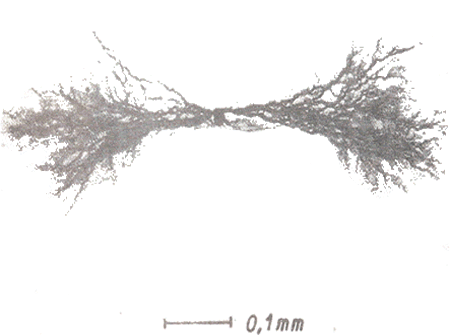
In figure 22.2 , bow tie type tree is shown, Eichhorn [4.4]. Such a tree developed at a void on the surface of the dielectric and grew up along it on both sides.
Fig 22.2 A bow tie type tree