| Breakdown and Prebreakdown phenomena in Solid Dielectrics |
| |
The prebreakdown phenomena in solid dielectrics leading to an irreversible rupture of the material (breakdown) is extremely complicated. In this process the local electric field, heat transport, charge injection and accumulation, mechanical stress, chemical and mechanical stability are all strongly and often nonlinearly coupled. Above all, the time factor affecting the breakdown makes the prebreakdown phenomena more complicated.
|
| |
Intrinsic Strength of Solid Dielectrics
|
As described in case of liquid dielectrics, the same definition of intrinsic strength holds good also for solid dielectrics. For a homogeneous and isotropic solid dielectric, the intrinsic strength is described as the highest value of electric strength obtainable after all known secondary effects leading to a premature breakdown (below intrinsic strength), seem to have been eliminated. |
The concept remains an ideal one and its validity is always dubious, as it is very difficult to know whether an observed breakdown was or was not intrinsic. One may conclude therefore, that the observed results are more likely to be intrinsic, the more they are independent of parameters like temperature, thickness and time. It is also extremely important that the test sample is prevented from self heating and mechanical distortions caused by the field. |
In order to measure intrinsic strength, preparation of the test samples is the utmost sensitive part involving a considerable amount of precision techniques. As described by Garton in [5.11], only two methods of measurement are seriously considered, the 'recessed specimen' and the 'McKeown's technique'. Lawson [4.1] measured the intrinsic strength of PE samples with the help of above mentioned specimens at different temperatures described in the following:
|
' Recessed Specimen '
|
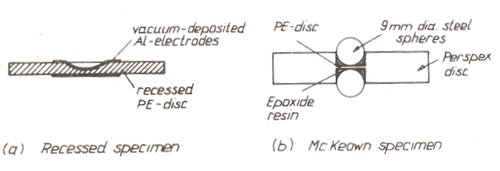
A spherical depression is either pressed, machined or ground on a ca. 1.5 mm thick plane disc sample of the material. It nearly penetrates the specimen, leaving only a thickness of approximately 50 µm, suitable for breakdown by a reasonable voltage, as shown in Fig. 21.1(a). The radius of the spherical depression should be such that a uniform field is achieved. The surfaces of the recess and of the opposite plane faces are then made conducting by a technique which provides an extremely good contact with the dielectric, for example, an evaporated film of aluminum, or a graphite coating applied by repeated spraying and polished to a continuous film. Liquid electrodes have also been tried. However, limitations like inadequate cooling of the stressed area and no mechanical support for the thin apex of the specimen remain with such electrodes. |
|
Fig 21.1 Specimens for the measurements of intrinsic strength, Lawson [ 4.1].
|
' McKeown Technique '
|
Two ball bearings used as electrodes in this specimen are located within a cylindrical hole in a disc made of suitable insulating material, such as Perspex. The lower ball is cemented in the position with an epoxyresin, and the hole filled with the same resin in liquid form. Then it is gently heated in partial vacuum until degassed. As shown in Fig. 21.2(b), the polyethylene test sample in the form of a thin film disc is placed in the hole on the top of the ball and the liquid is degassed again. Before encapsulation, the polyethylene film sample were treated chemically by immersion in concentrated chromic acid for five minutes to oxidize their surfaces and make a bond with the epoxide resin. The top ball is then inserted and the whole specimen cured until solid conditions are achieved. The thickness of the test sample assembled can be obtained by measuring the total thickness outside the balls and subtracting twice the diameter of the ball. A proper adhesion of the test sample material with the epoxyresin must be achieved to avoid any partial discharges or tracking on the interfaces. The specimen thus prepared may further require a chemical treatment with a solution of sodium in liquid ammonia in order to prevent corona discharges on the surfaces. |
As reported by Garton, both these techniques have proved extremely satisfactory at room temperatures for measuring the intrinsic strength of low-loss polymers. However, the results obtained by McKeown specimens have been consistantly higher than those obtained by the 'recessed' specimens.
|
|
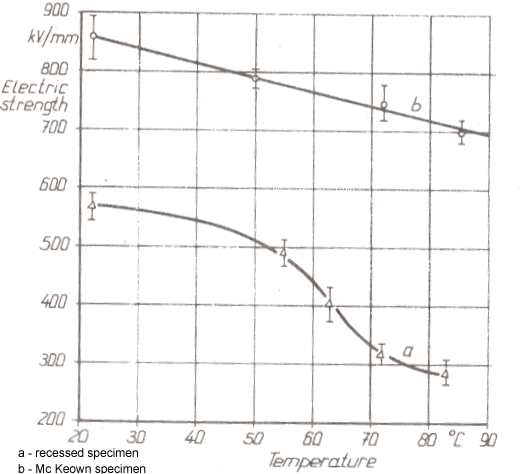
Fig 21.2 Variation of intrinsic electric strength of PE specimens with temperature, Lawson [4.1] .
|
Lawson [4.1] used McKeown techniques to measure the intrinsic strength of PE with increasing temperature between 20-85°C, as shown in Fig. 21.2. In his experiments, the breakdown tests were carried out under transformer oil to prevent flashover due to surface discharge. The applied voltage raised linearly with time, was obtained from a smoothed half-wave rectifier source. In these experiments, the breakdown occurred in about 15-20 s. In all cases the number of specimens tested were from six to eight, and 95% confidence limit of the mean was considered. |
Compared to the results obtained from recessed specimens, the fall of intrinsic strength with increasing temperature was greatly reduced by using McKeown specimens. Besides, altogether higher values of electric strength, of the order of 800 kV/mm, were obtained for PE. |
| |
The theories developed for intrinsic breakdown aim to arrive at a condition for an irreversible instability of the dielectric which is electronic in nature. These simply assume that in case of intrinsic breakdown the irreversible electronic catastrophe produces conditions in which the lattice is destroyed which is a temperature dependent phenomenon, Lawson [4.1].
The general aim of the measurement of intrinsic electric strength of the dielectrics has been to reveal the extreme complexity of the breakdown mechanism at very high electric fields rather than to find out electric strength. A breakdown in real life always occurs through some secondary mechanism or an external cause. Therefore, to conclude that a breakdown was intrinsic is mostly dubious. In practice, the solid dielectrics are stressed with maximum electric stress not greater than 3% of such high values of intrinsic strengths. |